
Table of Contents
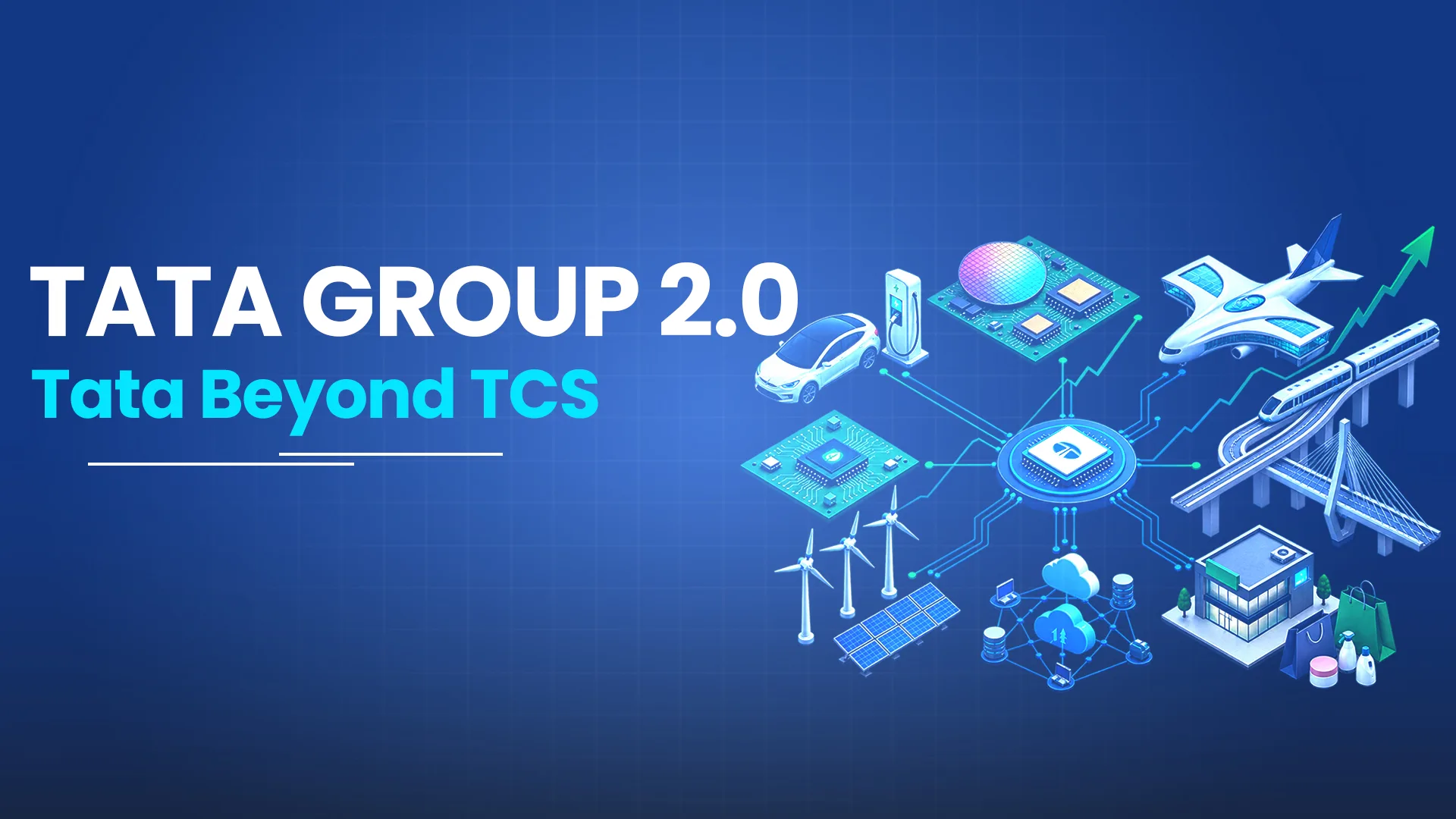
Tata Group is becoming far more than a TCS-led conglomerate. With Trent, Titan, Tata Steel, semiconductors, EV batteries, Air India and digital businesses gaining prominence, the group is entering a new phase of diversification. This article examines its growth drivers, investments, stock performance, capital requirements, execution challenges and key risks.
For over a decade, tracking Tata Group’s fortunes on the stock market largely meant tracking one stock which is Tata Consultancy Services. At its peak in March 2020, TCS accounted for nearly 74% of the combined market capitalisation of all listed Tata Group companies, according to data reported by Business Standard. As of June 2026, that share had fallen to just 30.8%, the lowest since TCS listed in August 2004, even as the group’s combined market capitalisation held above ₹25 lakh crore. That shift is not simply the story of one stock underperforming. It is the story of an entire conglomerate rebalancing around retail, automobiles, aviation, semiconductors, and batteries, alongside its original IT services anchor. This piece looks at how dependent Tata Group actually still is on TCS, which businesses are picking up the growth baton, where the group is placing its next big bets, and the risks that come with running this many large, capital-hungry businesses at once.
Is Tata Group Still Dependent on TCS?
TCS’s Role in Tata Group
TCS remains, by a wide margin, the single most valuable company inside Tata Group. Even after a difficult stretch through 2026, its market capitalisation of roughly ₹7.78-8.85 lakh crore (estimates vary slightly by source and date) still dwarfs every other group company, and TCS continues to be a major contributor to Tata Sons’ own profit and dividend income, which in turn funds much of the group’s expansion into newer, currently loss-making businesses. But the scale of TCS’s recent underperformance is what has forced the dependency question into the open. TCS’s market value fell from around ₹12.53 lakh crore at the end of May 2025 to ₹7.78 lakh crore by June 2026, a decline of roughly 38%, according to Business Standard’s reporting, and Storyboard18 separately noted that TCS alone erased more market value in the first half of 2026 than the entire Tata Group lost on a net basis over the same period, meaning gains elsewhere in the group were large enough to significantly cushion the group-level decline.
Tata’s Rising Non-TCS Businesses
The businesses cushioning that decline are increasingly diverse. Trent, the owner of the Zudio and Westside fashion chains, has been the standout, with Business Standard’s Q1 FY27 coverage describing it as leading the group on both revenue and profit growth momentum. Tata Steel and Titan have also been singled out by CNBC-TV18 and Storyboard18’s June 2026 coverage as among the biggest gainers even as the broader group’s market cap slipped, alongside positive contributions from Tata Power and Tata Technologies. This diversification means Tata Group’s fortunes are no longer a single-stock story. They are increasingly a portfolio story, where consumer retail, steel, power, and new-economy bets can offset a slowdown in the group’s largest legacy business.
Suggested Read: How did Titan become the jewel of Tata Group?
Which Tata Companies Are Driving Growth Beyond TCS?
Beyond TCS, a handful of companies now account for a meaningfully larger share of the group’s growth narrative than they did five years ago. Trent sits at the top of this list. Business Standard’s August 2026 coverage of Q1 FY27 group results describes it as
the fastest growing Tata group company over the last five years,
with sales growing 50% and operating profit rising 65% over that period, and it is projected to lead the group on revenue growth again in FY27 with an estimated 21% expansion. Titan Company, the group’s watches-and-jewellery major, has also been repeatedly flagged alongside Trent as a Q1 FY27 leader, with Tata Group chairman Noel Tata (who also chairs Trent) reiterating ambitions to grow Trent’s revenue roughly ten-fold from where it stood in 2023, a target he said in June 2026 commentary reported by Upstox was “in the not-so-distant future” given the business had already grown 2.5 times since then. Tata Steel’s India operations have also been resilient, per Business Standard, offsetting weaker European performance, while Tata Power and Tata Technologies have posted positive share price momentum through the group’s otherwise difficult first half of 2026. It’s worth noting that Tata Motors, historically one of the group’s largest contributors by revenue, underwent a structural change in FY26. Its commercial vehicle business was demerged into a separate listed entity, TML Commercial Vehicles Ltd, effective October 1, 2025, with the passenger vehicle and Jaguar Land Rover businesses retained under the renamed Tata Motors Ltd from October 29, 2025, which is why several recent group-wide performance comparisons exclude Tata Motors or treat it separately during this transition period.
Tata’s New Growth Bets: Where Is the Next Opportunity?
Semiconductors
Tata Electronics has become the group’s most closely watched new bet, and the numbers reflect that. Its revenue reached ₹1.31 lakh crore in FY26, up nearly 97% year-on-year, making it the group’s fourth-largest subsidiary by revenue, according to comments from N Chandrasekaran. The centrepiece project is a ₹91,000 crore wafer fabrication plant in Dholera, Gujarat, developed with Taiwan’s PSMC, which reached roughly 50% construction completion by mid-2026 with trial production targeted for late 2026, per multiple industry trackers including AUM Realties and Dholera Times. A separate ₹27,000 crore semiconductor assembly and test (OSAT) facility in Jagiroad, Assam, is already operational, positioning it as India’s first semiconductor unit in the northeast. This scale of investment comes with a scale of losses to match during the buildout phase. Tata Electronics’ reported losses grew from ₹70 crore in FY25 to ₹1,611 crore in FY26 even as management described the business as having reached operational breakeven, a reminder that headline profitability claims and statutory financial results can reflect different scopes of the business.
Batteries and EV Ecosystem
Agratas, Tata’s global battery arm, is building parallel gigafactories in Sanand, Gujarat (20 GWh first-phase capacity) and Bridgwater, Somerset, UK (40 GWh), representing a combined investment north of ₹50,000 crore, according to Cartoq’s 2026 coverage of the projects. The Sanand plant’s steel structure was completed in April 2026, with cell production targeted for 2027, while the UK plant, delayed from its original 2026 opening, is now expected to open its first building in 2027 as well, per BBC reporting, and has separately secured a £380 million UK government grant. Early customers for both plants are expected to be Tata Motors and Jaguar Land Rover, positioning Agratas as a captive supplier that could meaningfully reduce the group’s reliance on external battery cell imports as its EV volumes scale.
Air India
Air India represents the highest-stakes, and currently highest-loss, bet in the group’s new-business portfolio. Tata took control of the airline in January 2022 and merged it with Vistara in November 2024, creating a combined entity in which Singapore Airlines holds a 25.1% stake. The turnaround has proven far more expensive than initially expected. Air India Group posted a loss of roughly $2.8 billion (disclosed via Singapore Airlines’ own FY26 results, since Air India itself is unlisted and does not separately file with Indian regulators) for the year ended March 2026, its largest annual loss since the Tata acquisition, taking cumulative losses since 2022 above ₹58,000 crore, per Finnovate’s May 2026 analysis. Contributing factors cited across multiple reports include elevated fuel costs, Pakistan’s airspace closure to Indian carriers (estimated by the airline at around $600 million in added cost), supply chain delays affecting cabin upgrades, and the operational complexity of integrating Vistara. CEO Campbell Wilson’s planned departure in 2026 adds a leadership transition on top of the financial pressure, and Business Standard reported in June 2026 that N Chandrasekaran had begun personally conducting weekly reviews of the airline’s operations, flight operations, and finance functions, underlining how closely Tata Sons is now managing the turnaround.
Digital Businesses
Tata Digital, the umbrella for Tata Neu, BigBasket, Croma, Tata 1mg, and Tata CLiQ, posted a net loss of ₹4,974 crore in FY26, widening from ₹4,610 crore in FY25, even as revenue grew 11.9% to ₹35,990 crore, according to Tata Sons’ own annual report as covered by Inc42 and CXO Digitalpulse. BigBasket alone accounted for roughly 64% of that loss, with its losses widening 66% year-on-year as it invested heavily in quick-commerce infrastructure to compete with Blinkit, Zepto, and Swiggy Instamart. In response, Tata Sons has begun repositioning Tata Neu away from its original everything super-app ambition toward a narrower focus on financial services, payments, and loyalty, including growing its co-branded credit card base, and has overseen a leadership transition at both BigBasket and Tata 1mg as founder-CEOs stepped back in favour of more centrally managed leadership, per SightsIn Plus’s April 2026 reporting.
How Have Tata Group Stocks Performed?
Performance across the group has diverged sharply by business rather than moving together, which is itself a sign of how far Tata Group has moved from being a single-stock proxy. Over the roughly nine-year period N Chandrasekaran served as Tata Sons chairman (February 2017 to his August 2026 resignation), the group’s combined listed market capitalisation grew from about ₹8.22 lakh crore to ₹23.35 lakh crore, according to Business Today’s analysis of his tenure, a near-tripling driven overwhelmingly by companies other than TCS in percentage terms, even though TCS remained the largest single contributor in absolute rupee value for most of that period. In the first half of 2026 specifically, TCS’s roughly ₹4 lakh crore market value decline exceeded the Tata Group’s net ₹3.6 lakh crore decline over the same window, meaning the rest of the group, in aggregate, actually gained value even as TCS fell, per Storyboard18’s June 2026 reporting.
Which Tata Stocks Have Created the Most Value?
Measured over N Chandrasekaran’s roughly nine-year tenure as Tata Sons chairman, August 2026 analysis found more than a dozen Tata Group stocks had turned multibaggers.
- Trent led by a wide margin, rising approximately 1,790%, meaning a ₹1 lakh investment at the start of his tenure would have grown to roughly ₹17.9 lakh by August 2026.
- Nelco (Tata’s satellite communications arm) rose around 1,115%
- Tata Investment Corporation gained roughly 1,050%
- Titan Company rose approximately 1,015% over the same period.
- Tata Consumer Products and Indian Hotels Company gained around 660% and 540% respectively, while smaller, less-followed group names like Benares Hotels (+790%) and Automotive Stampings and Assemblies (+640%) also delivered outsized returns.
- Tata Elxsi, Tata Power, Tata Steel, and Voltas each roughly tripled to quadrupled in value (up 400%, 350%, 300%, and 255% respectively)
- TCS itself, alongside Tata Chemicals, Tayo Rolls, and TRF, delivered more modest gains in the 15-90% range over the same window
- Rallis India was a rare decliner, down about 13%.
These figures, compiled from a single point-in-time analysis, are illustrative of historical returns over one specific leadership tenure and should not be read as a forecast of future performance for any of these companies.
What Are the Biggest Risks to Tata Group’s Growth?
Capital expenditure
Tata Group’s new growth bets are collectively enormous in capital terms, roughly ₹91,000 crore for the Dholera semiconductor fab alone, ₹27,000 crore for the Assam OSAT facility, over ₹50,000 crore combined for the Sanand and UK battery gigafactories, and Air India’s separate, previously announced multi-billion-dollar aircraft order and cabin retrofit programme. Funding this scale of investment while several of these businesses remain loss-making for years puts real pressure on group cash flow, and much of that funding burden has historically flowed through TCS’s dividend upstream to Tata Sons, which makes TCS’s own performance relevant to the group’s capex capacity even as its share of market value shrinks.
Execution risk
Semiconductor fabrication, gigawatt-scale battery manufacturing, and full-service international airline turnarounds are all businesses Tata Group has limited or no prior operating history in, unlike its century-plus track record in steel, autos, or hospitality. Timelines have already slipped in places: Agratas’s UK gigafactory’s first building was pushed from 2026 to 2027, and Air India’s turnaround, originally framed around a five-year Vihaan.AI transformation plan starting in 2022, is now well into its fifth year with losses still widening rather than narrowing.
Valuation
Some of the group’s best-performing stocks now trade at rich multiples reflecting years of strong execution and growth expectations already priced in; Trent, for instance, trades at a significant premium to book value following its multi-year rally, according to Screener.in data. A valuation built on continued 20%+ growth leaves comparatively little room for disappointment, and a slowdown in same-store sales or store expansion pace at any of the group’s premium-rated consumer businesses could trigger a sharper-than-average correction relative to slower-growing, more reasonably valued peers.
TCS slowdown
TCS’s own operating performance has weakened alongside its stock price. The company’s workforce fell by 23,460 employees over FY26, against an originally announced restructuring plan of around 12,200 job cuts, according to reporting citing TCS’s own quarterly disclosures, while revenue growth has been muted amid what CEO K Krithivasan has acknowledged is a period where high single-digit growth may remain elusive near-term. The disruption narrative extends beyond one company: GenAI-driven productivity tools are widely cited across the Indian IT sector as structurally reducing the historical link between revenue growth and headcount growth, a shift that, if it persists, could keep pressure on TCS’s growth and margin profile, and by extension on the dividend income Tata Sons has historically relied on from its largest subsidiary.
New-business losses
Air India’s roughly $2.8 billion FY26 loss and Tata Digital’s ₹4,974 crore FY26 loss are, taken together, a substantial and currently widening drag on group-level profitability, even as both businesses post strong revenue growth. Neither loss is forecast by the companies themselves to disappear quickly: Air India’s turnaround has repeatedly been described by Tata leadership and outside analysts as a multi-year project, and BigBasket’s losses widened even as the broader Tata Digital portfolio’s GMV grew, reflecting the ongoing cost of competing in India’s capital-intensive quick-commerce market.
Leadership transition
This risk has become acutely current: N Chandrasekaran resigned as Tata Sons chairman on August 12, 2026, days ahead of a contentious annual general meeting, after a board deadlock over extending his term beyond February 2027, according to Business Standard’s reporting on his resignation letter. Chandrasekaran, who took over from Cyrus Mistry in February 2017, has asked the Tata Sons board to begin a formal succession process, and Bloomberg described the abrupt exit as deepening “a leadership crisis” at a moment when the group is simultaneously executing its largest-ever capital programme across semiconductors, batteries, and aviation. How, and how smoothly, Tata Trusts and the Tata Sons board select and transition to a successor is now a live, unresolved variable for every major initiative discussed in this article, from Air India’s weekly-reviewed turnaround to the semiconductor fab’s 2026 production targets.
Conclusion
The data supports the framing in this article’s title: Tata Group’s fortunes are demonstrably less tied to a single company than they were even five years ago, with TCS’s share of group market value falling to a record-low 30.8% by mid-2026 even as the group’s overall value has multiplied several times over under N Chandrasekaran’s tenure. But “less dependent on TCS” does not mean “lower risk.” The businesses picking up the growth mantle, semiconductors, batteries, aviation, and digital commerce, are collectively more capital-intensive, less proven, and currently less profitable than the IT services business they are diversifying away from, and the group is navigating this transition during an unplanned leadership succession. For anyone tracking Tata Group stocks, the more useful lens going forward may not be “how is TCS doing” but “which specific Tata business, and at what stage of its own investment cycle.”
To track how individual Tata Group companies are performing on fundamentals and momentum as new quarterly results and the Tata Sons succession process unfold, StockEdge’s sector screeners and Investment Themes tool can help filter and monitor these companies over time.
FAQs
1. What is driving Tata Group’s growth beyond TCS?
Growth beyond TCS is currently being driven primarily by Trent, Titan Company, a resilient India operation at Tata Steel, and positive momentum at Tata Power and Tata Technologies.
2. Which Tata companies are growing the fastest?
By revenue and profit growth over the past five years, Trent has been described by Business Standard as the fastest-growing Tata Group company, with sales up roughly 50% and operating profit up around 65% over that period, and it is projected to lead the group on revenue growth again in FY27.
3. What are Tata Group’s new business investments?
The group’s major new investments span four areas: semiconductors, with a roughly ₹91,000 crore wafer fab in Dholera, Gujarat, and a ₹27,000 crore assembly and test facility in Assam; EV batteries, with gigafactories under construction in Sanand, Gujarat, and Somerset, UK, worth a combined ₹50,000 crore-plus; aviation, through Air India’s multi-year turnaround and fleet renewal following its 2022 acquisition and 2024 Vistara merger; and digital commerce, through Tata Digital’s portfolio of Tata Neu, BigBasket, Croma, Tata 1mg, and Tata CLiQ.