
Retail investing has become more accessible than ever. Small-time investors can get the data they need to make decisions and pay relatively small fees for the infrastructure needed to place their investments, and, in a way, compete with the biggest investment companies.
However, there are still mistakes that retail investors most often make that experts and large funds can avoid. This is due to the lack of experience and hands-on relationship with the companies they are supporting. Investors tend to focus on price momentum and market trends while overlooking fundamental warning signs.
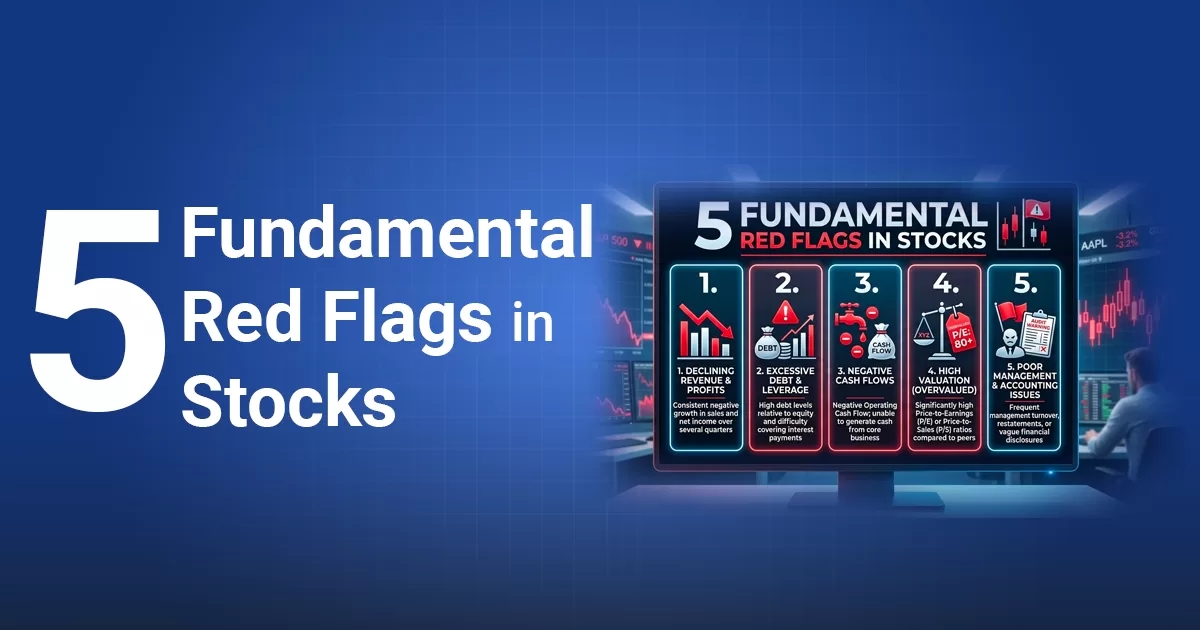
In this article, we’ll go over some red flags investors should be aware of that point to a problem with the company that may be hiding in plain sight.
Red Flag #1: Earnings Growth Without Cash Flow
One of the most common warning signs that something is wrong with the business is the difference between its earnings and cash flow. That means that the quality of the net earnings is to be questioned.
There are many reasons for such a gap. Management may be using aggressive revenue recognition, extending credit to customers to boost sales, or capitalizing expenses that should be recognized immediately. A business could also rapidly sign up new accounts or get new inventory, but without ways to monetize them.
Retail investors often focus on earnings without considering how a company performs day to day. Cash flow shows a business is stable, with money coming in regularly from customers and clients.
Operating cash flow over multiple quarters is one of the most important metrics for investors to track.
Red Flag #2: Rising Debt with No Clear Growth Strategy
Many companies take on debt, and it’s a useful tool. It can be used for expansion, acquisitions, or productive investment. It can also be a legal trick used to lower taxes. All of these uses are fine, but if a company keeps taking on more debt and it’s not growing, it’s a red flag.
Companies can also use debt to cover operational costs and to fund share buybacks designed to support the stock price or maintain dividends. If debt is used in this way, it won’t lead to growth.
Taking on a company with a lot of debt means that interest rates on future debt will only rise, and the company will have less financial flexibility if it isn’t servicing its debts. A heavily leveraged company could also lose its assets and face equity dilution.
The metric to watch when investing is the debt-to-equity ratio and net debt relative to earnings. The interest coverage ratio—operating income divided by interest expense—is particularly important. If the company isn’t doing well, by this metric, it won’t be able to service the debt. Some investors also follow the relationship between borrowing and operational performance. Every new debt a business takes on should make it more productive or help it expand.
Red Flag #3: Consistent Insider Selling (Without Insider Buying)
Corporate insiders, such as executives, directors, and senior managers, know more about the company than outsiders, and they often sell before other owners. Insider selling isn’t uncommon, but if it happens too often and there’s no insider buying, it could be a sign of trouble.
There are many reasons for insiders to sell, and they aren’t always bad. Sometimes, it’s about diversification, taxes, or planning compensation. However, if multiple insiders sell regularly over several quarters, it’s a sign they don’t trust the company.
If there’s no insider buying during periods of price weakness, it could also be a red flag. The management should be a stock if they think it’s undervalued. Failing to do so shows that they don’t really trust the company; they know best.
It’s best to follow such trends across multiple insiders and executives over a long period of time. It will show a pattern and, therefore, a lasting, undelaying truth about the company. If there are such patterns, showing the insiders aren’t optimistic about their own business, it’s best not to invest in it.
Red Flag #4: Complex or Opaque Business Models
Investors should be cautious about companies with complex, difficult-to-understand business models. Complexity in itself isn’t a problem, but if the business structure is opaque, it means the investors can’t truly assess the company.
There are a few ways to spot such a business model. It includes: frequent changes in reporting segments, heavy reliance on adjusted or non-GAAP earnings, unclear revenue sources, or a large network of subsidiaries and special entities. When these are combined, an investor can’t determine a business’s underlying profitability.
The basic question is simple. When investors ask themselves, “how does this company make money?”, they should know the answer.
History shows that there are always warning signs that a company may not be doing as well as it seems. One such sign is accounting complexity and a lack of transparency. It’s a sign that many investors miss since it requires going into the details of how a business is run.
Retail investors don’t have the resources needed to get such information, while big investment funds have teams that can do the work. Companies with a simple, effective revenue plan are usually the most profitable. Crypto experts, such as those at CCN, have written about companies that exist solely to provide crypto exposure to those who don’t want to buy coins themselves. All these companies do is buy crypto, and investors purchase shares of these companies instead of owning crypto directly. The business model is simple but effective.
Red Flag #5: Extreme Valuation Driven by Narrative, Not Fundamentals
For many companies, the value comes from the narrative the business has built about itself. It’s this narrative that attracts investors and creates hype, which in turn drives more investment. However, in the end, a business needs to be profitable and provide value. If it’s based solely on narrative, it will come crashing down at some point.
Narrative-driven stocks typically trade at valuation multiples well above those of their industry peers. Investors often believe these are justified because the company will eventually dominate the market. When that doesn’t happen, the stock price will drop just as quickly.
All of these effects are multiplied by social media and smart marketing aimed at retail investors in particular. There are basically no ways to get rich quickly, and companies that promise such a thing are usually either a scam or a mistake. Investors should choose their investments based on clear, measurable features and qualities rather than hype.
Conclusion
There are a few common red flags for investors that indicate a company isn’t doing as well as it seems and isn’t safe to invest in. Retail investors are usually the last to pick up on these, since they don’t have the resources to analyze the investment.
Some of these are about how the company uses debt, others are about the business structure, and others are about the difference between revenue and cash flow. A good investment isn’t about the narrative it sells, but about provable ways to earn. It also means a lot to follow how those with insider knowledge about the company trade.