

In 2018, the Nifty PSU Bank Index was a symbol of everything that had gone wrong in India’s public sector banking space.
PSU banks were reporting massive losses. Cumulative losses crossed ₹85,000 crore in FY2018. Gross NPAs had surged from ₹2.67 lakh crore in 2015 to ₹8.45 lakh crore by March 31, 2018. Investor confidence collapsed.
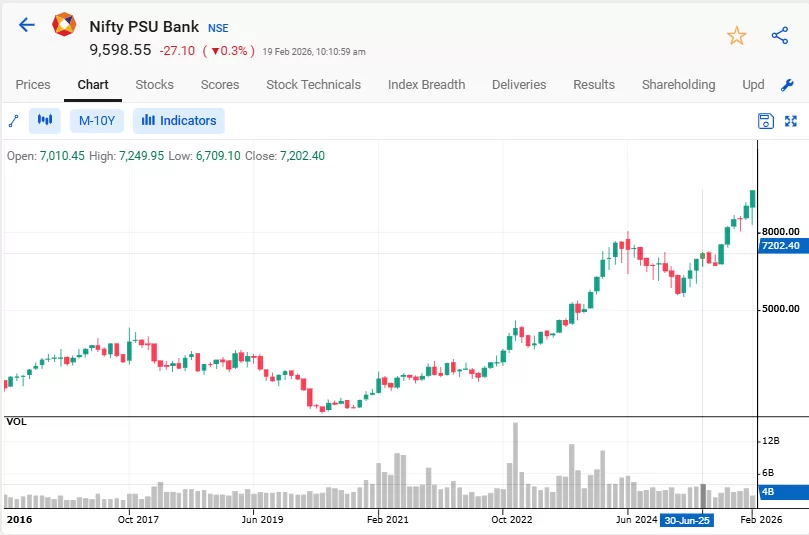
And the market reflected that stress clearly. The Nifty PSU Bank Index fell nearly 65.37% across 2018, 2019, and 2020.
But markets move in cycles, and so do sectors. Fast forward to today, and the same index is telling a completely different story.
As of January 30, 2026, the Nifty PSU Bank Index delivered a 42.77% return over one year, making it one of the strongest-performing sectoral indices in the Indian market.
So what exactly changed?
In this blog, we will understand the reasons behind this turnaround and take a closer look at what the Nifty PSU Bank Index is, how it works, which banks it comprises, and what drives its movement.
What is Nifty PSU Bank?
The Nifty PSU Bank Index is basically a scorecard that tracks how India’s government-owned banks are doing.
It is managed by the NSE and only includes banks where the government owns at least 51%.
Only PSU banks that are listed and actively traded on the National Stock Exchange of India, and meet minimum listing history and liquidity requirements, are eligible for inclusion in the Nifty PSU Bank Index.
Composition of Nifty PSU Bank Index
The index currently consists of 12 stocks. These banks represent the largest and most liquid public sector lenders in the country.
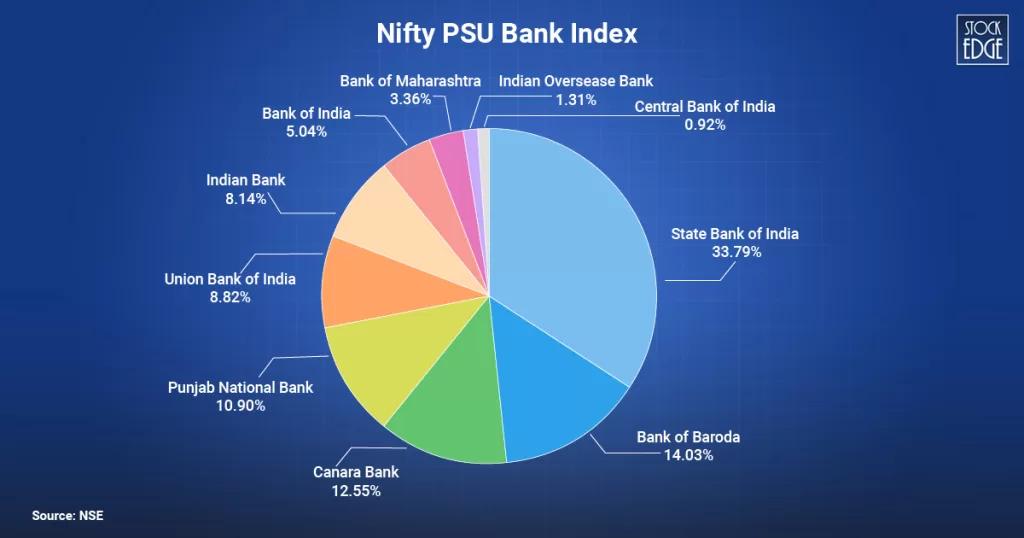
How the Nifty PSU Bank Index Works
The Nifty PSU Bank Index works on a free-float market capitalisation weighted methodology, but before understanding weightage, it is important to understand how banks become part of the index.
Stock Selection Criteria of Nifty PSU Bank
Not every PSU bank automatically enters the index. A bank must satisfy the following conditions:
- It must rank within the top 800 companies based on average daily turnover and average daily full market capitalisation over the last six months.
- At least 51% of its shareholding must be held by the Central or State Government, directly or indirectly.
- The stock must have traded on at least 90% of trading days in the last six months, ensuring liquidity.
- It must have a minimum listing history of one month as of the cutoff date.
- Final selection among eligible banks is based on free-float market capitalisation.
These rules ensure that the index includes only large, liquid, and investable public sector banks.
Once selected, each stock’s weight in the index is determined by its free-float market capitalisation (market cap excluding government holdings). This means larger banks with higher free-float market cap get higher weight. And smaller banks have lower impact on index movement.
However, to prevent excessive concentration:
- No single stock can have more than 33% weight.
- The combined weight of the top three stocks cannot exceed 62% at the time of rebalancing.
This ensures diversification while still reflecting sector leadership.
Factors That Affect Nifty PSU Bank Performance
The performance of the Nifty PSU Bank Index is influenced by multiple macroeconomic, policy-driven, and sector-specific factors.
Since the index consists entirely of government-owned banks, it is particularly sensitive to economic cycles and regulatory developments. Below are the key factors:
Government Policies & Reforms
Public sector banks are majority-owned by the government, so policy decisions directly impact their operations and valuations.
Announcements related to recapitalisation, consolidation, governance reforms, or privatisation can significantly influence investor sentiment. Structural reforms that improve autonomy and operational efficiency often lead to positive re-rating of the sector.
Asset Quality (NPA Trends)
Non-Performing Assets (NPAs) have historically been a major concern for PSU banks. Rising NPAs increase provisioning requirements and reduce profitability, while improving asset quality strengthens earnings and balance sheets.
A visible decline in stressed assets typically boosts confidence in the sector.
Credit Growth
Strong credit growth drives higher interest income and profitability. PSU banks often benefit during periods of infrastructure expansion, corporate capex cycles, and increased MSME or retail lending demand.
Sluggish credit growth, on the other hand, can limit earnings momentum.
Interest Rate Environment
Changes in interest rates affect net interest margins (NIMs). Rising rates may improve margins initially but can also increase the risk of loan defaults if borrowing costs rise sharply.
A stable and predictable rate environment generally supports steady banking performance.
Economic Growth (GDP Trends)
PSU banks tend to perform better during strong economic growth phases. Higher GDP growth improves borrower repayment capacity, reduces stress in loan books, and increases demand for credit. Economic slowdowns, however, can lead to rising delinquencies and pressure on earnings.
Capital Adequacy & Fundraising
Adequate capital buffers enable PSU banks to expand lending operations. Government capital infusion or improved internal accruals strengthen financial stability. Weak capital positions can restrict loan growth and affect investor confidence.
Profitability & Return Ratios
Sustained improvement in profitability metrics such as Return on Equity (ROE) and Return on Assets (ROA) often leads to valuation re-rating. Efficiency improvements, lower cost-to-income ratios, and stable margins contribute to long-term performance of the index.
Regulatory Changes
Changes in RBI norms regarding provisioning, capital requirements, or lending standards can impact profitability. Regulatory tightening may increase compliance costs, while relaxation in norms can temporarily support earnings.
Market Sentiment Toward PSU Theme
Broader re-rating of public sector enterprises across sectors such as defence, railways, or energy often lifts PSU banks as well. Positive sentiment toward government reforms can attract institutional and retail participation in the index.
Performance of Major Constituents
Since the index follows a free-float market capitalisation methodology, heavily weighted stocks like State Bank of India can significantly influence overall index movement. Earnings surprises or sharp price movements in top constituents can drive the index direction.
Historical Performance of Nifty PSU Bank
Between 2015 and 2025, the performance of Public Sector Banks (PSUs) witnessed a dramatic turnaround. The cycle began with the Asset Quality Review (AQR) in 2015, which exposed previously unrecognised stress in bank balance sheets. This led to a sharp spike in Non-Performing Assets (NPAs), peaking in 2018. However, through structural reforms, balance sheet clean-up, and capital strengthening, the sector has transitioned to record profitability and significantly improved asset quality by FY 2024–25.
This revival was driven by the Government’s 4R strategy:
- Recognition of NPAs in a transparent manner
- Resolution & Recovery, supported by the Insolvency and Bankruptcy Code (IBC)
- Recapitalisation of PSUs
- Reforms in governance and banking operations
Additionally, the establishment of the National Asset Reconstruction Company Ltd. (NARCL) has played a critical role in cleaning bank balance sheets by acquiring over ₹1.05 lakh crore of stressed assets as of January 2025. Importantly, all PSUs that were once under the Prompt Corrective Action (PCA) framework have now exited it.
Key Performance Indicators: Then vs Now
1. Asset Quality
The most visible improvement has been in asset quality. Following the AQR in 2015, banks began recognising stressed loans transparently, causing NPAs to surge and peak in March 2018. Since then, steady recoveries and improved credit discipline have brought NPAs down to multi-year lows.
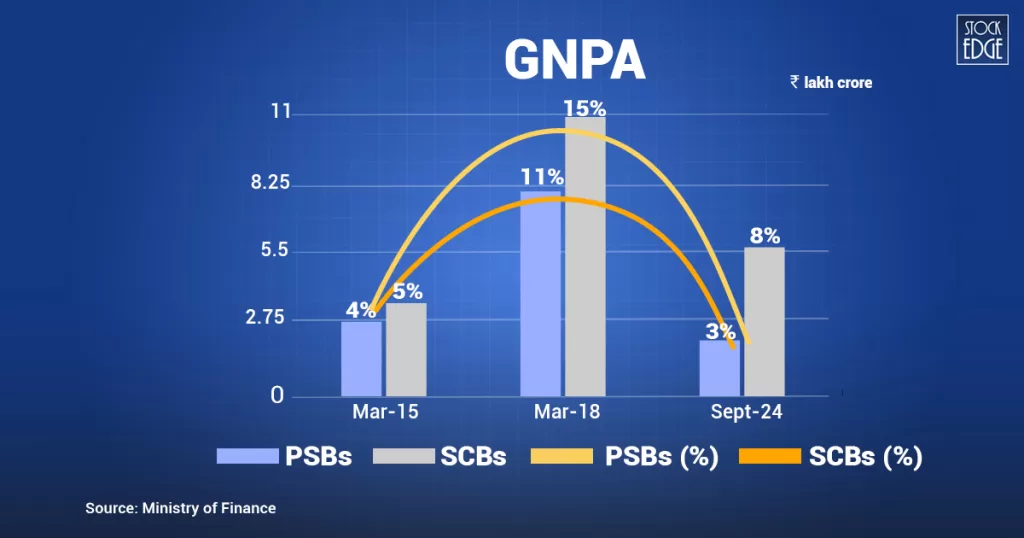
This sharp reduction reflects improved underwriting standards, recoveries under IBC, and disciplined provisioning.
2. Capital Adequacy
The capital position of PSUs has improved considerably, enhancing their lending capacity and risk absorption ability.
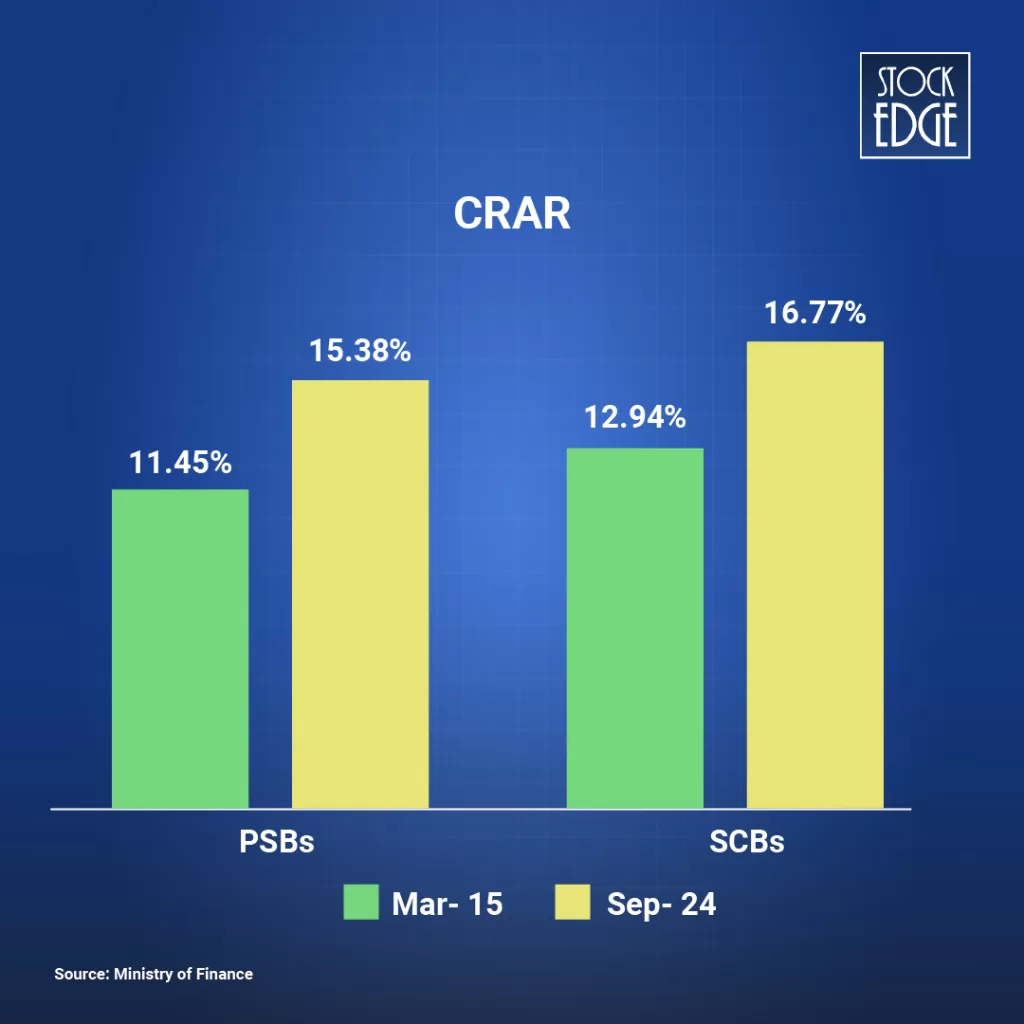
This strengthening ensures compliance with regulatory norms and supports future credit growth.
3. Profitability
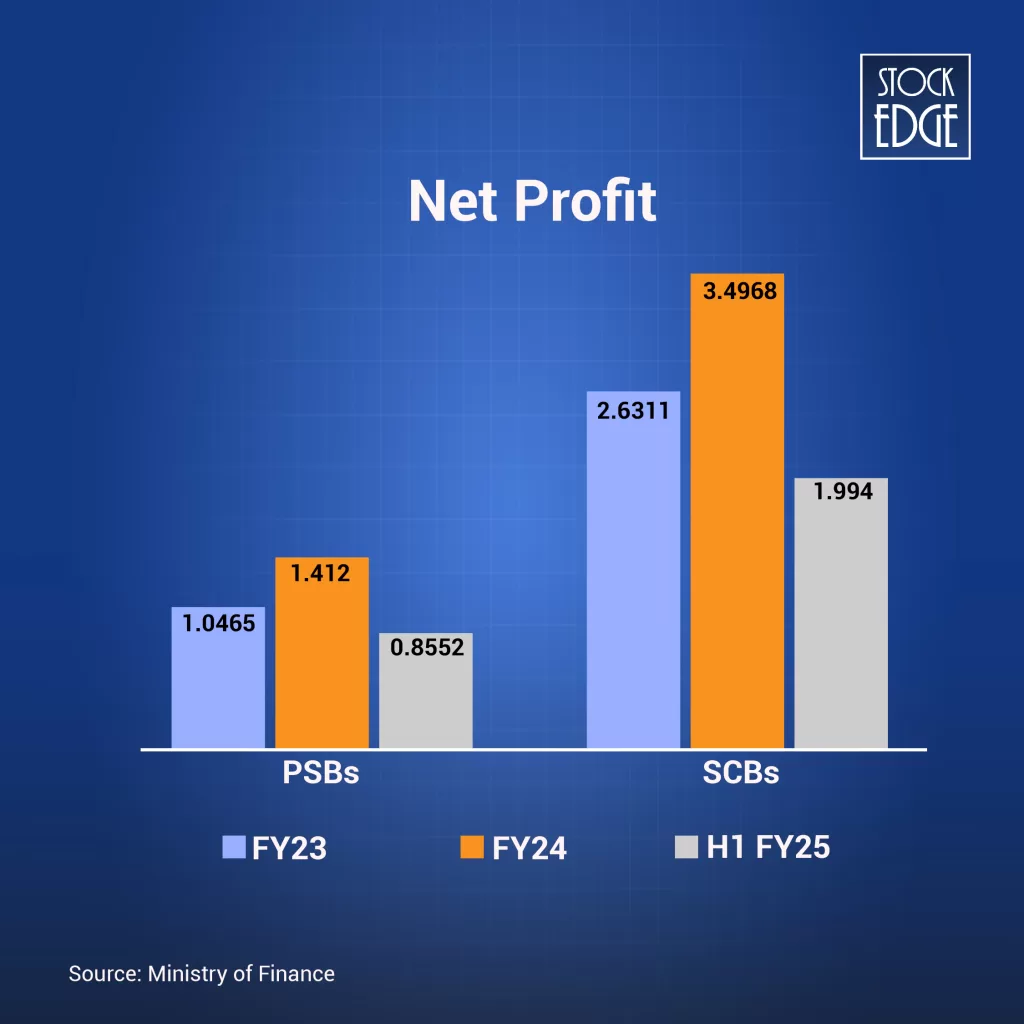
After years of stress-induced losses due to high provisioning, PSUs have returned to sustained profitability.
4. Capital Mobilisation
There has been a structural shift in capital raising. Earlier, PSUs relied heavily on government recapitalisation. However, improved financial performance has enabled them to access capital markets independently. Total Market Mobilisation (FY15–FY25 up to Dec 31, 2024) ₹4.72 lakh crore raised through equity and bonds
This reflects rising investor confidence and stronger financial fundamentals and the impact is clearly visible in the performance of the PSU Bank index, which has responded positively to the sector’s improved asset quality, profitability, and capital strength.
Conclusion
The journey of Public Sector Banks from the NPA crisis of 2015–18 to record profitability in 2024–25 represents one of the most significant structural recoveries in India’s banking history. Transparent recognition of stress, regulatory reforms, capital strengthening, and disciplined recovery mechanisms have collectively restored stability, profitability, and market confidence in the PSU ecosystem.
Read: What is Nifty Pharma? Top Stocks, Weightage & How It Works
Frequently Asked Questions (FAQs)
1. What is the difference between PSU banks and private banks?
PSU banks are majority-owned (at least 51%) by the Government of India, while private banks are owned primarily by private shareholders. PSU banks often focus on public policy objectives, whereas private banks emphasize profitability and operational efficiency.
2. How many stocks are in the Nifty PSU Bank Index?
The Nifty PSU Bank Index comprises 12 listed public sector banks traded on the NSE. It represents the performance of the largest and most liquid PSU banks in India.
3. What is free-float market capitalisation in Nifty PSU Bank?
Free-float market capitalisation considers only the shares available for public trading, excluding government holdings. This method ensures the index reflects the investable portion of PSU bank stocks.
4. Which bank has the highest weightage in Nifty PSU Bank?
Generally, State Bank of India has the highest weightage due to its large free-float market capitalisation. However, no single stock can exceed 33% weight during rebalancing.
5. How often is the Nifty PSU Bank Index rebalanced?
The index is rebalanced semi-annually. During this process, stock eligibility, free-float market cap, and weight limits are reviewed and adjusted accordingly.