
The automobile sector is one of the most closely watched indicators of India’s economic momentum. From rising incomes and credit availability to policy shifts and technological disruption, auto stocks tend to reflect changes in consumer sentiment faster than many other sectors.
The Nifty Auto Index captures this dynamic by tracking India’s leading automobile and auto ancillary companies, making it a useful barometer for investors seeking exposure to domestic demand, manufacturing growth, and the evolving mobility landscape.
In this blog, we explore what the Nifty Auto Index is, how it works, the key factors that influence its movement, and the risks investors should understand before investing in auto stocks.
What is the Nifty Auto Index?
Nifty Auto is a free-float market capitalization–weighted index comprising the most liquid and large automobile and auto ancillary companies listed on the NSE. It reflects the behaviour and performance of the automobile sector, which includes manufacturers of cars & motorcycles, heavy vehicles, auto ancillaries, tyres, etc. The index comprises of maximum of 15 stocks, and the base date of the index is January 1, 2004.
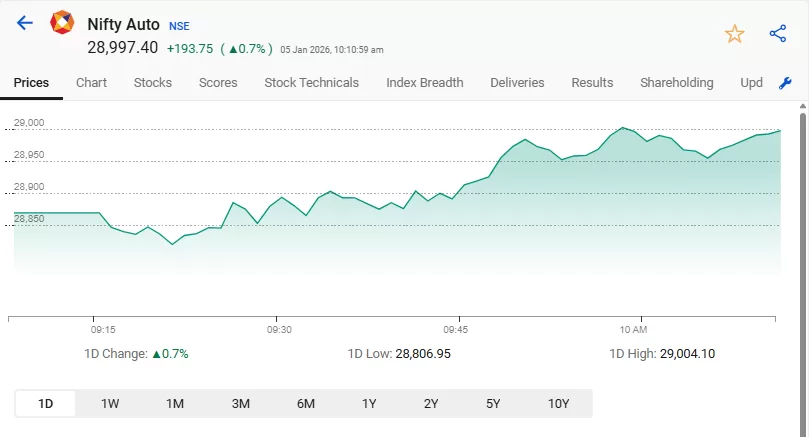
Composition of Nifty Auto
The composition of Nifty Auto spans across multiple sub-segments of the auto value chain. Passenger vehicle manufacturers and diversified OEMs command the highest weight, followed by two-wheeler manufacturers and auto ancillary leaders. Below is the list of Components of NIFTY Auto as of December 2025:

How Does Nifty Auto Work?
Nifty Auto is a free-float market capitalisation weighted index, meaning each stock’s influence depends on the value of shares available for public trading. Companies with larger free-float market capitalisation have higher weight and therefore move the index more. As a result, price changes in large automobile manufacturers impact Nifty Auto more significantly than smaller auto ancillary stocks.
Stock Selection and Eligible Universe
Nifty Auto is a child index, and its stocks are selected from the Nifty 500, which acts as the parent universe. Only companies that belong to the automobile or auto ancillary sector and are part of the Nifty 500 are normally eligible. The index aims to maintain a minimum of 10 constituents. If eligible auto stocks within the Nifty 500 fall below this number, the selection universe is expanded step-by-step to larger ranked universes based on average daily turnover and full market capitalisation, ensuring sufficient liquidity and representation.
Preference is given to stocks that are traded in the NSE Futures & Options (F&O) segment, as these stocks are typically more liquid. Non-F&O stocks can be included only if they meet additional stability criteria, such as limited instances of hitting upper or lower price circuits—specifically, circuit hits must be less than 20% of total trading days over the previous six months.
Index Review and Rebalancing
The Nifty Auto index is reviewed semi-annually, using data for the six months ending January and July. During this review, companies are ranked in descending order of average free-float market capitalisation, and final selection is made based on this ranking. To avoid frequent changes, a company is included only if its free-float market capitalisation is at least 1.5 times that of the smallest existing index constituent.
After the review, stock weights are recalculated and changes are implemented prospectively. This structured and rules-based process ensures that Nifty Auto remains liquid, stable, and representative of India’s automobile sector, reflecting shifts in leadership, demand cycles, and sector growth over time.
What Moves Nifty Auto?
The Nifty Auto index is primarily moved by the performance of its 15 constituent stocks, which include major manufacturers of passenger vehicles, two-wheelers, commercial vehicles, and auto components like tyres and batteries. Beyond individual company performance, the index is heavily influenced by broader economic factors and government policies.
Key Factors Influencing Nifty Auto
- Overall Economic Conditions & Consumer Demand: The auto sector is cyclical and highly sensitive to the broader economy. A rising Nifty Auto often signals economic recovery, as increased disposable incomes and consumer confidence lead to higher vehicle sales.
- Government Policies & Regulations: Policy shifts can be major game-changers. Examples include changes in Goods and Services Tax (GST) rates, which make vehicles more or less affordable, new safety or emission standards, and incentive schemes for electric vehicles (EVs), such as the FAME scheme.
- Interest Rates & Credit Availability: Since most vehicles are purchased on loan, interest rate changes directly affect affordability and consumer spending power. Lower interest rates tend to boost sales and the index’s performance.
- Raw Material Prices: The profitability of auto companies is closely tied to the cost of raw materials like steel, aluminum, rubber, and precious metals. Volatility in commodity prices can impact profit margins and stock movements.
- Technological Advancements: The global shift towards electric vehicles (EVs) and related technologies is a major disruption. Companies that adapt quickly and invest in EV development, like Tata Motors and TVS Motor, see their stock performance benefit.
- Supply Chain Disruptions: Issues in complex global supply chains, such as the recent semiconductor shortages, can halt production and impact the financial performance of companies within the index.
- Rural vs. Urban Demand: Performance can be segmented by vehicle type. For instance, sales of two-wheelers are heavily influenced by rural demand and the monsoons, while sales of four-wheelers, including passenger vehicles, reflect urban consumer sentiment.
Also Read: Top 5 Automobile Stocks in India
Risks to Know Before Investing
Investing in Nifty Auto stocks involves significant risks due to the sector’s highly cyclical nature and sensitivity to various external factors. These investments are generally considered high-risk and are better suited for investors with a high-risk appetite and a long-term horizon.
Key risks to know before investing include:
Economic and Cyclical Risks
- High Cyclicality: The auto sector is inherently cyclical, meaning its performance is closely tied to the overall health of the economy. During economic downturns or recessions, consumers often delay “big-ticket” purchases like vehicles, which can lead to significant drops in sales and profitability.
- Sensitivity to Interest Rates and Fuel Prices: Auto stocks are highly sensitive to macroeconomic conditions such as interest rates, credit availability, and fuel prices. Higher interest rates increase the cost of vehicle financing for consumers, while high fuel prices increase ownership costs, both of which can depress demand.
- Demand Slowdown: Factors like inflation, weak labor markets, and affordability pressures can directly impact consumer discretionary spending, leading to a lack of demand for vehicles.
Industry and Company-Specific Risks
- Regulatory Changes: Government policy shifts regarding emissions, safety standards, or taxes can necessitate rapid adjustments by companies, impacting their operations and financials.
- Technological Transition (EV Shift): The transition to electric vehicles (EVs) is a major disruption. Companies failing to adapt their products, manufacturing, and supply chains for EVs risk losing market share.
- Supply Chain Disruptions: The industry relies on complex global supply chains. Disruptions from events like semiconductor shortages or geopolitical tensions can halt production.
- Intense Competition: The sector is highly competitive, leading to pressure on pricing and margins.
Investment-Specific Risks
- Concentration Risk: The Nifty Auto Index is concentrated in a limited number of stocks, with a few dominant players heavily influencing its performance.
- Higher Volatility: The Nifty Auto Index has historically shown greater volatility and sharper declines during market corrections compared to broader indices.
- Foreign Exchange Fluctuations: Companies importing raw materials are susceptible to fluctuating exchange rates, affecting costs and profitability.
Conclusion
The Nifty Auto Index provides focused exposure to India’s automobile ecosystem, covering manufacturers and ancillary companies that are closely linked to economic cycles, policy decisions, and technological change. Its rule-based construction, semi-annual review process, and free-float market capitalisation weighting ensure that the index remains liquid, investable, and representative of sector leadership over time.
However, given its cyclical nature and relatively higher volatility, Nifty Auto is best approached with an understanding of demand cycles, interest rate trends, regulatory developments, and the ongoing transition toward electric mobility.
For investors who can look beyond short-term fluctuations and align their strategy with structural growth drivers, Nifty Auto can play a meaningful role in a diversified equity portfolio.
Read: What is NIFTY 500 & How To Invest?
Frequently Asked Questions (FAQs)
1. How often should I track Nifty Auto?
Investors should track Nifty Auto based on their investment horizon. Short-term traders may monitor it daily or weekly for tactical opportunities, while long-term investors can review it monthly or quarterly, focusing on structural drivers such as demand trends, EV adoption, and policy changes rather than short-term price movements.
2. How can investors analyse trends within Nifty Auto more effectively?
Investors can analyse trends more effectively by combining fundamental data with relative strength analysis. Tracking earnings revisions, ROCE trends, and valuation bands alongside sector rotation indicators helps identify leadership stocks early.