In today’s fast-moving markets, most traders focus only on price action charts, breakouts, and momentum. But the truth is, Price tells you what is happening, not whether it should be happening. Relying only on technicals means chasing moves without understanding their strength, quantity without quality.
Quality + Quantity = Better Decisions
- Technicals (Quantity): When to enter
- Fundamentals (Quality): What to buy
When both align, trades have a higher probability of success.
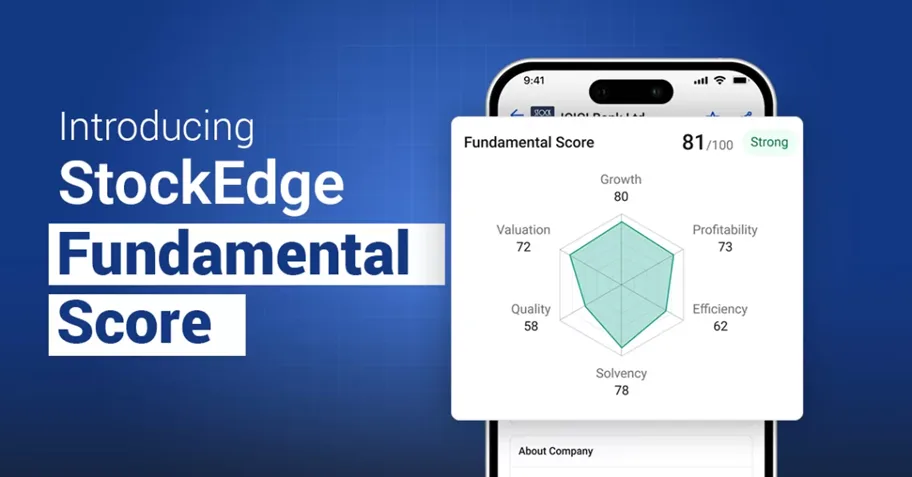
That’s exactly where the Fundamental Score on StockEdge comes in.
What is StockEdge’s Fundamental Score?
Fundamental Score is a single, easy-to-understand number (out of 100) that reflects the overall financial strength of a company. Instead of analyzing dozens of financial ratios individually, this score combines 30+ key financial parameters into one powerful metric.
It combines:
- Quantitative factors (growth, profitability, debt, cash flow)
- Qualitative factors (promoter quality, institutional interest)
What goes behind the score?
The score is not random, it is built on six critical pillars of a company’s financial health:
- Growth: Are sales and profits growing consistently?
- Profitability: How efficiently is the company generating profits?
- Efficiency: Is the business utilizing its assets well?
- Solvency: Can the company manage its debt safely?
- Quality: How reliable is management and shareholding structure?
- Valuation: Is the stock reasonably priced or overvalued?
Each of these parameters contributes to the final score, giving you a 360-degree view of the company.
Why does this matter?
Let’s understand this with a simple example. A stock may show a strong breakout on charts, but if its fundamentals are weak. Declining profits, rising debt, and poor cash flows often result in the move failing.
On the other hand, stocks with strong fundamentals tend to show:
- Better trend sustainability
- Strong institutional participation
- Lower downside risk during corrections
This is why combining fundamentals with technicals can significantly improve decision-making.
Example:
Take two well-known stocks:
- A stock like Bank of Maharashtra shows a high Fundamental Score (90+), indicating strong growth, profitability, and balance sheet strength. Not surprisingly, it is also supported by strong momentum scores, suggesting alignment between fundamentals and price.
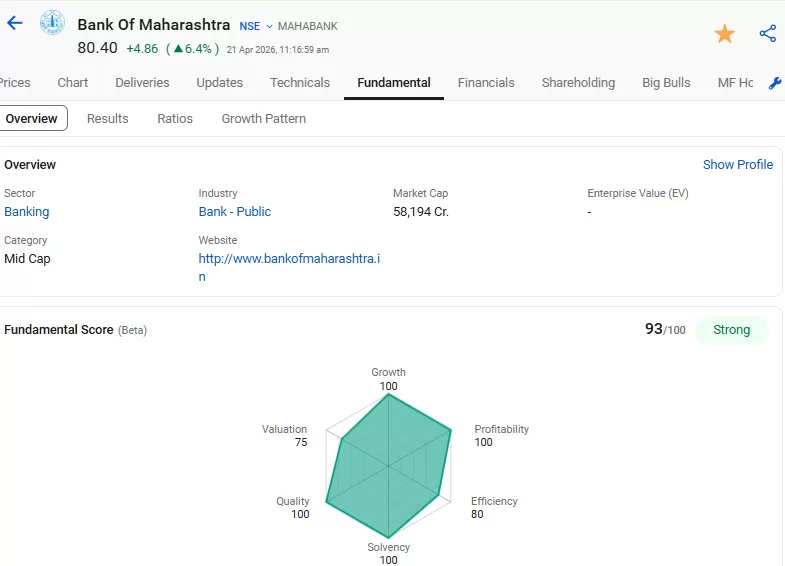
Check the Fundamental Score of Bank of Maharashtra
- On the other hand, a large-cap like Reliance Industries may have a moderate score (~60). While still fundamentally stable, it may not show the same level of aggressive growth or momentum at a given time.
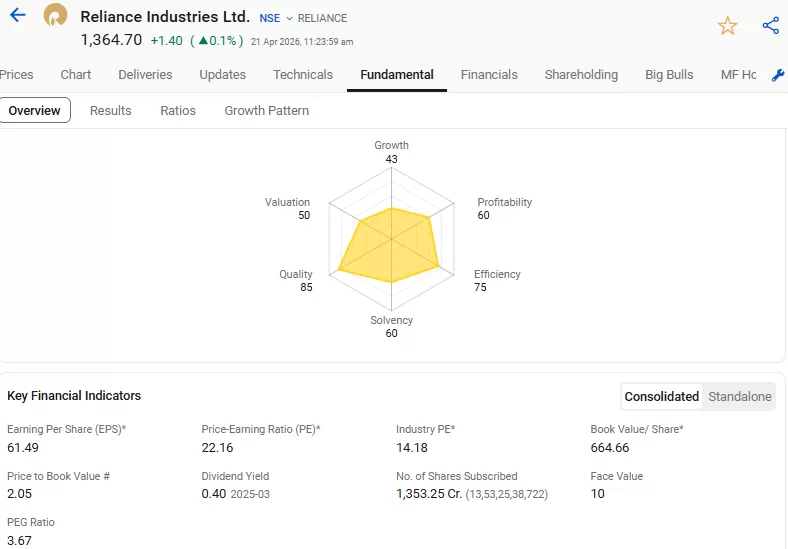
Check the Fundamental Score of Reliance Industries Ltd.
This comparison highlights a key insight:
Not all large companies are high-growth opportunities at all times.
How can you use Fundamental Score?
1. Stock Selection: Instead of scanning hundreds of stocks, filter those with high scores (above 60–70) to focus on fundamentally strong candidates.
2. Better Swing Trading: Even for swing traders, fundamentals matter more than you think. Use the score to:
- Avoid weak stocks that fail after breakout
- Focus on stocks with higher probability of follow-through
- Combine with your existing strategy (RS, EMA, Supertrend)
3. Portfolio Building: For investors, this score acts as a quick health check before adding any stock to the portfolio.
4. Risk Management: A declining score can act as an early warning sign before the price starts correcting.
The real edge: Fundamentals + Momentum
StockEdge already provides powerful tools like Momentum Scores across multiple timeframes. When you combine that with Fundamental Score, you unlock a powerful strategy:
- High Fundamental Score + High Momentum = Strong Candidates
- Low Fundamental Score + High Momentum = Risky Trades
This combination helps you move from guesswork to data-driven decisions.
Let’s take Bank of Maharashtra as a case study. On StockEdge, the stock shows:
- Fundamental Score: 90+ (Strong)
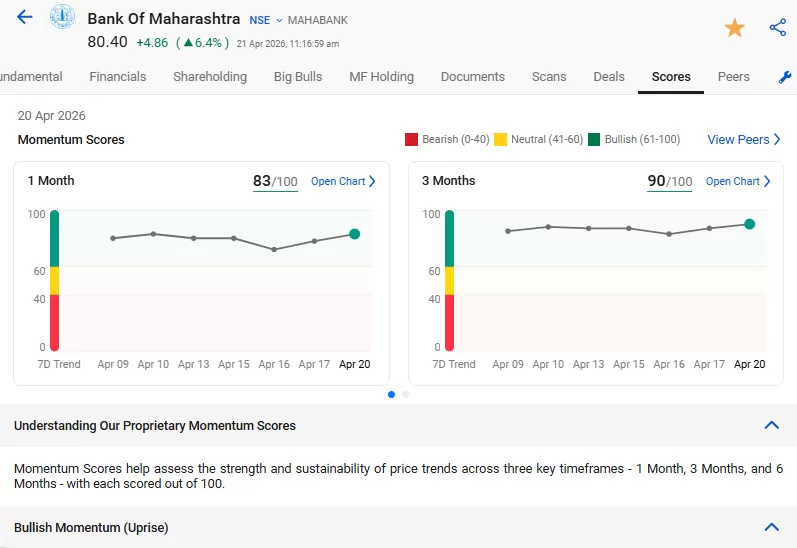
- Momentum Score (1–3 months): 80–90 (Bullish)
Check the Momentum Score of Bank of Maharashtra
Now, what does this actually mean?
From a fundamental perspective, the bank has been showing strong earnings growth and improving profitability.
- Net profit has grown consistently, with recent quarters showing near 35% YoY growth
- ROE is above 20%+, indicating efficient capital usage
- Profit growth CAGR has been strong over the last few years
At the same time, the price action confirms it:
- The stock rallied near 13% in just a few sessions after the results
- Momentum scores stayed in the bullish zone
Suggested Read: How to Use StockEdge Score Scans
Peer Comparison Insight: Why Bank of Maharashtra stands out
One of the most powerful ways to use Fundamental Score is not just in isolation but in comparison with peers.
Let’s take the Bank of Maharashtra example further. In the PSU banking space, when we compare key players:
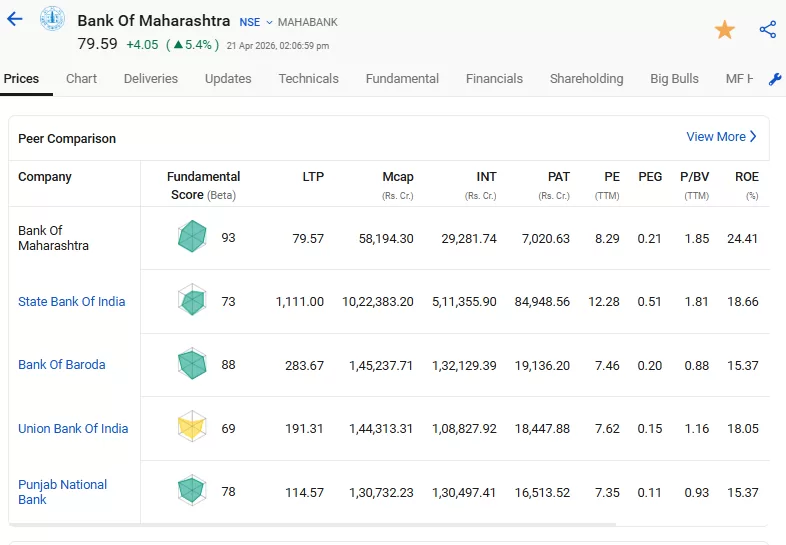
- Bank of Maharashtra → Fundamental Score: 93
- Bank of Baroda → 88
- State Bank of India → 73
- Punjab National Bank → 78
- Union Bank of India → 69
Despite being a mid-cap bank, Bank of Maharashtra is scoring higher than even large players like SBI.
Now, why does this matter? Because the score reflects relative strength within the sector, not just absolute numbers. When you dig deeper:
- ROE is higher (24%+) compared to peers
- Profitability and growth metrics are stronger
- Valuation is still reasonable
This creates a powerful combination:
👉 Stronger fundamentals + relatively better efficiency + sector leadership
Designed for simplicity, built for impact
One of the biggest challenges in fundamental analysis is complexity. Most investors either ignore it or get overwhelmed by too many ratios.
Fundamental Score solves this by:
- Simplifying analysis
- Saving time
- Making data actionable
Whether you are a beginner or an experienced trader, it helps you make faster and smarter decisions.
Final Thoughts
Markets reward those who can filter noise and focus on quality. Fundamental Score is not just another metric; it’s a decision-making tool that brings clarity in a cluttered market. If you’ve been relying only on charts, it’s time to upgrade your approach. Because the best trades are not just technically strong, they are fundamentally backed.
Frequently Asked Questions (FAQs)
1. What parameters make up the StockEdge Fundamental Score
It evaluates a company across six pillars: growth, profitability, efficiency, solvency, management quality, and valuation.
2. What is a good Fundamental Score?
A score above 60–70 is generally considered fundamentally strong.
3. How is Fundamental Score different from reading financial ratios?
Instead of analyzing dozens of ratios separately, StockEdge Fundamental Score combines 30+ key financial parameters into one number that is faster to read and act on.