
Every time you stream a 4K video, settle a bill via UPI, or query an AI model, you are initiating a high-speed physical transaction within a sprawling, climate-controlled fortress of silicon and steel. These facilities, Data Centres, are the invisible backbone of our digital existence.
India has already established itself as a global titan of data consumption. Yet, we are witnessing a profound structural irony. While the nation generates a massive share of the world’s digital exhaust, it is only just beginning to build the silos to store it. For the sophisticated investor, this gap isn’t just a logistical hurdle; it is a signal of a massive valuation re-rating in a sector that is fast becoming India’s “Digital Oil.”
What is the Data Centre Sector?
A data centre is more than just a warehouse for computers. It is a mission-critical facility providing the environment required for the storage, processing, and distribution of digital services.
Types of Data Centres
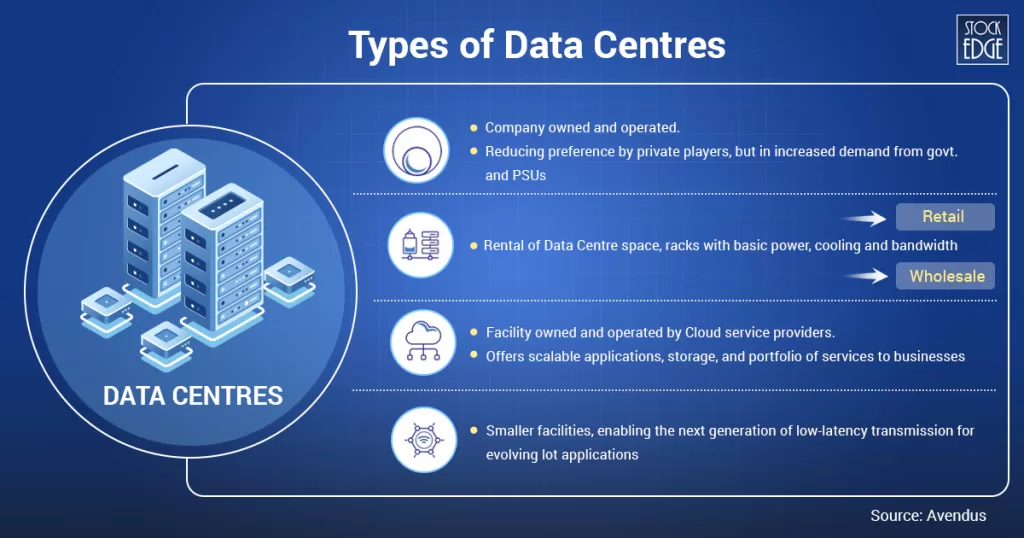
The core of these facilities consists of five pillars: Servers, Storage, Networking, Power, and Cooling. Depending on the tenancy model, the industry categorizes these assets into four distinct types:
- Captive: Company-owned and operated. While private enterprise preference is waning, demand remains robust from Government and PSU sectors.
- Colocation (Retail/Wholesale): The “rental” model, where space, racks, power, and cooling are leased to multiple tenants.
- Hyperscale: Massive facilities owned by cloud service providers (CSPs) to provide scalable applications and global storage portfolios.
- Edge: Smaller, localized hubs designed for low-latency transmission, essential for the next generation of IoT and autonomous applications.
Why the Data Centre Sector is Structurally Attractive?
Globally, the data centre industry is expected to reach approximately $600 billion in size, growing at a double-digit CAGR.
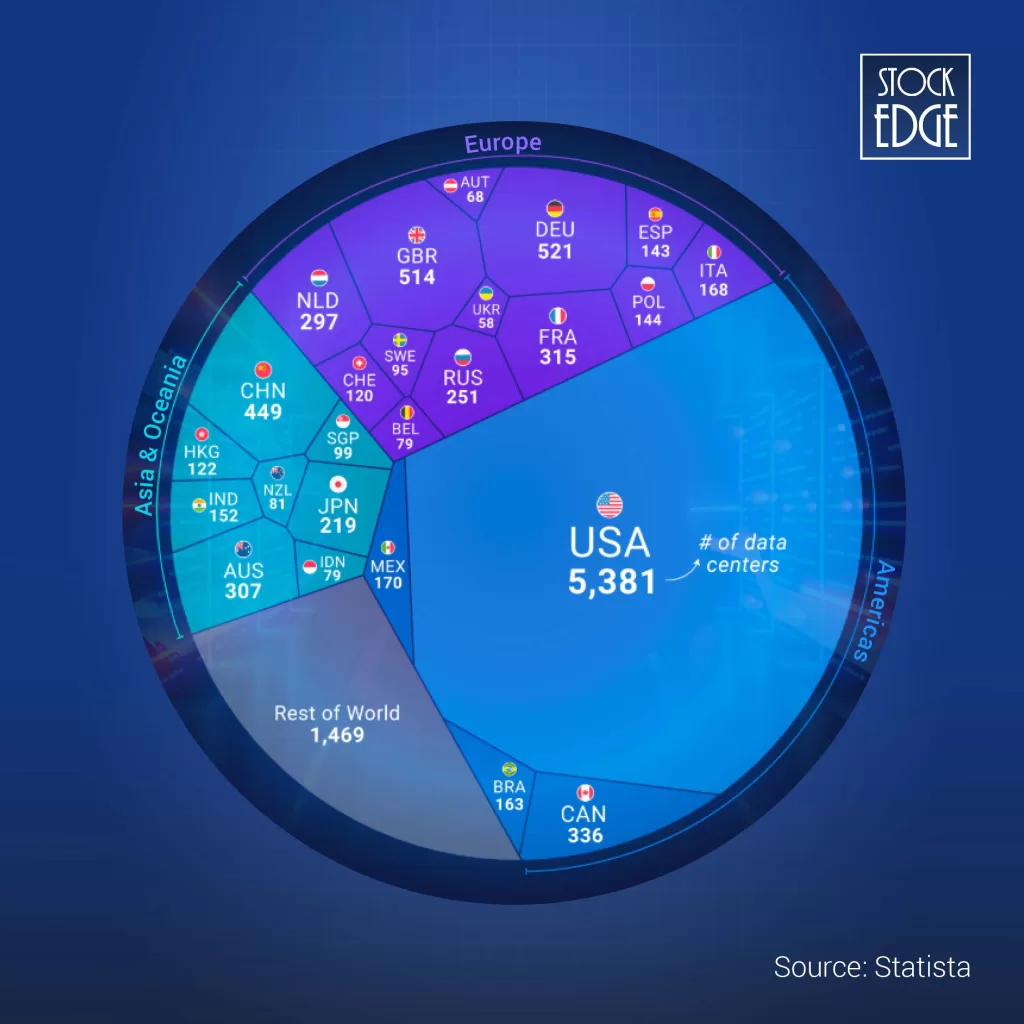
This expansion is supported by sustained cloud migration, enterprise digitisation, AI workloads, and increasing consumer internet usage. The United States remains the largest market with thousands of operational facilities, benefiting from early cloud adoption and hyperscaler concentration.
However, the most compelling opportunity lies in markets like India. India generates nearly 20 percent of global data but accounts for only around 3 percent of global data centre capacity. This imbalance indicates a long runway for infrastructure creation.
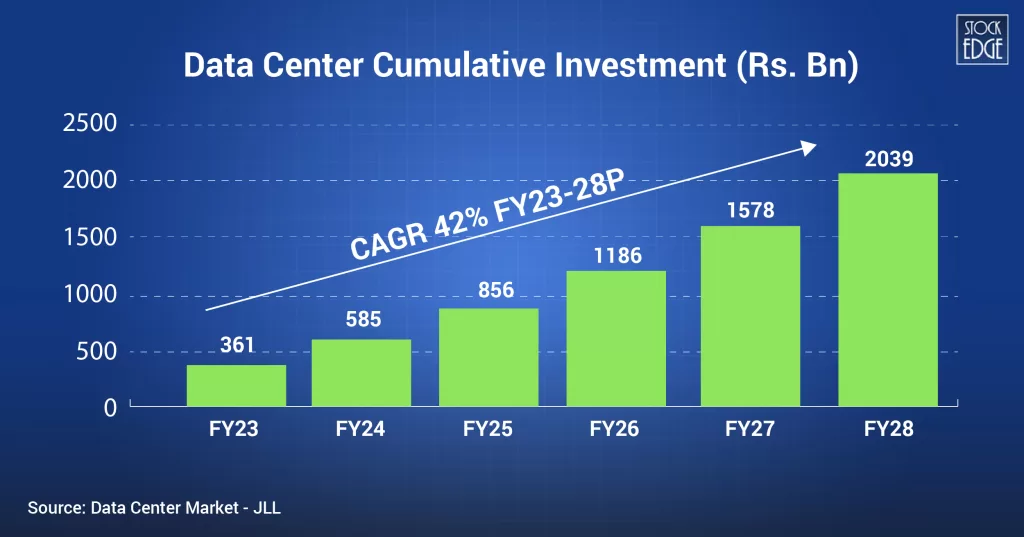
As of March 2024, India had just over 1,000 MW of operational capacity across more than 160 facilities. Installed capacity is projected to double within a few years, reflecting a high growth trajectory.
India’s per-user data consumption is rising sharply and is expected to exceed many developed markets in the coming years. The combination of a large population, affordable mobile data, rapid smartphone penetration, and widespread digital adoption creates sustained demand for server capacity. Unlike cyclical sectors that depend on short-term demand fluctuations, data centres are supported by structural digital transformation trends.
Key Drivers of the Data Centres Sector
Let’s look at the key drivers of the data centres sector
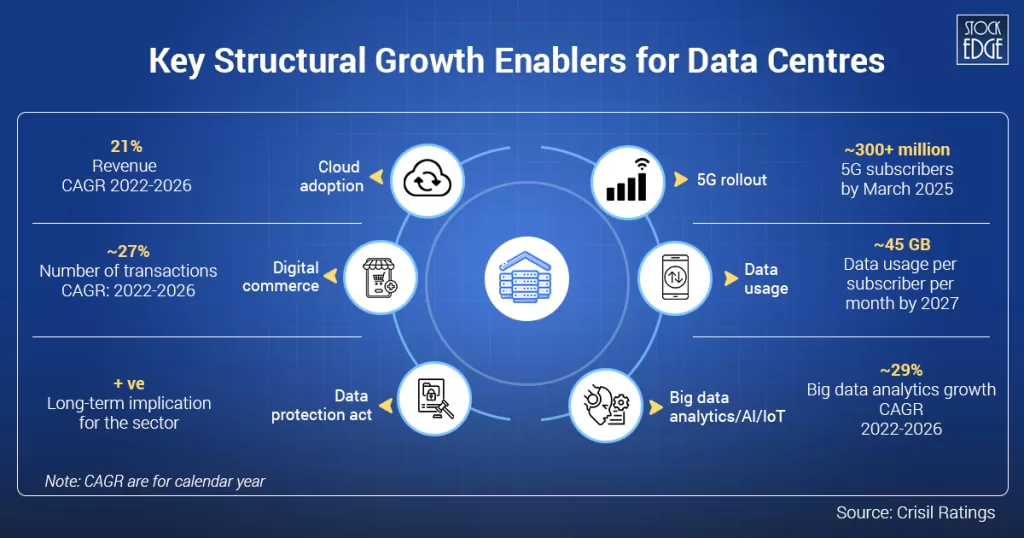
Mobile Internet and 5G Expansion
India’s data consumption story is fundamentally anchored in mobile internet penetration. Affordable data tariffs, rising smartphone adoption, and the nationwide rollout of 5G have dramatically increased bandwidth usage.
5G technology enables ultra-low latency and higher speeds, allowing real-time applications such as HD streaming, online gaming, IoT ecosystems, and smart city solutions to function seamlessly.
Each incremental GB consumed requires backend storage, processing, and transmission capacity. As monthly per-user data consumption continues to rise, the demand for scalable data centre infrastructure grows proportionately.
Artificial Intelligence and High-Performance Computing
Artificial intelligence is no longer experimental; it is becoming enterprise infrastructure. AI workloads require massive computational power, particularly GPU-intensive clusters designed for training and inference models.
Unlike traditional cloud workloads, AI significantly increases rack density and power consumption per MW. This shift structurally enhances revenue potential for data centre operators because AI-driven facilities command higher power utilisation and premium pricing. The rapid integration of AI across BFSI, healthcare, manufacturing, and government services is expected to accelerate demand for AI-ready data centres in India.
Cloud Adoption and Enterprise Digital Transformation
Indian enterprises are steadily migrating from on-premise IT systems to cloud-based infrastructure. Public cloud, hybrid cloud, and colocation models are becoming standard operating frameworks for modern businesses. This transition is driven by scalability, cost efficiency, cybersecurity considerations, and business continuity planning. As organisations modernise their digital architecture, they require reliable, secure, and scalable data centre capacity. Hyperscalers and domestic cloud players are therefore expanding their footprint, directly contributing to increased demand for hyperscale campuses and colocation facilities.
E-commerce and Digital Payments Growth
India’s digital commerce ecosystem has expanded rapidly, supported by unified payment systems, fintech innovation, and growing internet penetration. Every online transaction involves authentication, processing, fraud detection, and secure storage. As digital payment volumes and e-commerce orders increase, backend infrastructure must scale accordingly. The rise of quick commerce, digital banking, and real-time settlement systems further intensifies demand for low-latency, high-availability data centre infrastructure.
Government Initiatives Supporting the Sector
20-Year Tax Holiday for Cloud Services
In a significant policy move, the government has proposed a long-term tax incentive framework for foreign cloud service providers using MeitY-notified Indian data centres. The provision of a 0 percent tax structure extending up to 2047 aims to attract global hyperscalers to establish large-scale infrastructure within India.
Such long-duration visibility improves return predictability and enhances India’s positioning as a competitive digital infrastructure destination in Asia. This initiative signals strategic intent to integrate India into the global cloud supply chain.
Production-Linked Incentive (PLI) Scheme for IT Hardware
The ₹17,000 crore PLI scheme for IT hardware manufacturing provides incentives on incremental sales of servers and storage equipment. Since servers and storage systems form the technological core of data centres, domestic manufacturing support reduces import dependency and strengthens supply chain resilience.
Over time, localised hardware production can improve cost competitiveness and accelerate ecosystem development around digital infrastructure.
Proposed Data Centre Incentivisation Scheme (DCIS)
The proposed Data Centre Incentivisation Scheme, with an estimated outlay of around ₹12,000 crore, is designed to provide capital and interest support to developers. Although still in draft stages, the scheme reflects the government’s recognition of data centres as strategic infrastructure assets. By lowering financing costs and improving project viability, such support mechanisms can accelerate large-scale capacity addition.
State-Level Fiscal Incentives
Several states have introduced targeted data centre policies to attract investment. Maharashtra offers stamp-duty exemptions and power-duty waivers. Tamil Nadu provides stamp-duty reductions and electricity-duty exemptions for a defined period. Telangana supports projects through land allocation benefits, building-fee rebates, and power incentives. These state-level measures reduce upfront costs and improve internal rates of return for developers, making India’s leading metro clusters competitive with global hubs.
Top 5 Stocks of Data Centres
Reliance Industries Ltd.
Reliance Industries represents a powerful strategic entrant into India’s digital infrastructure ecosystem. Through its digital arm and telecom subsidiary, Reliance has built one of the largest data traffic networks in India.
The company’s strength lies in its integrated digital ecosystem — spanning telecom, fibre connectivity, cloud ambitions, enterprise solutions, and retail digitisation. With its aggressive push into digital services and AI-led infrastructure, Reliance is expected to play a major role in large-scale data infrastructure creation.
Reliance benefits from:
- Massive telecom subscriber base generating large volumes of data
- Strong fibre and connectivity backbone
- Deep capital resources for large-scale infrastructure deployment
- Renewable energy ambitions aligning with green data centre needs
As AI adoption accelerates and enterprise cloud demand expands, Reliance’s ability to integrate connectivity, cloud, and compute infrastructure could make it a central player in India’s long-term data centre growth narrative.
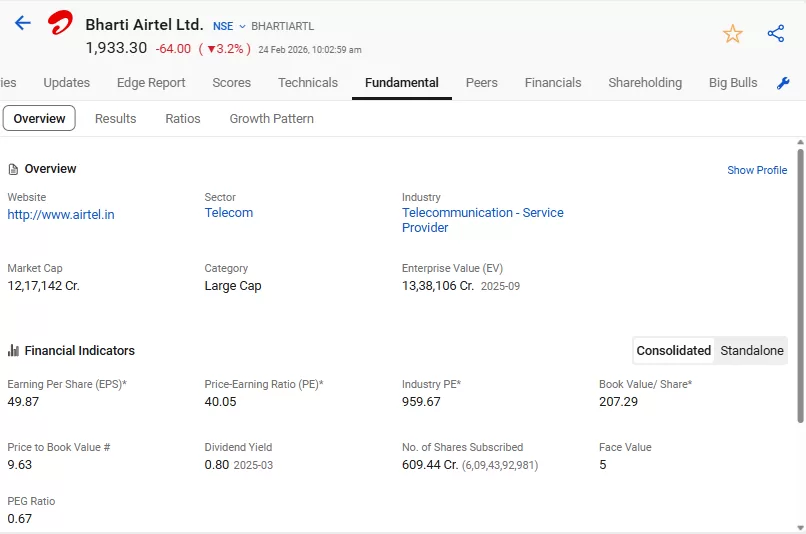
Larsen & Toubro Ltd.
Larsen & Toubro is one of India’s largest engineering and infrastructure conglomerates, and its entry into the data centre space reflects the sector’s strategic importance. Through its platform L&T Cloudfiniti, the company is building and operating AI-ready data centre infrastructure while leveraging its deep EPC capabilities.
L&T’s competitive advantage lies in its integrated execution strength from civil construction and electrical systems to automation and digital integration. Its facilities in Chennai and Navi Mumbai are designed to support hyperscale and AI workloads.
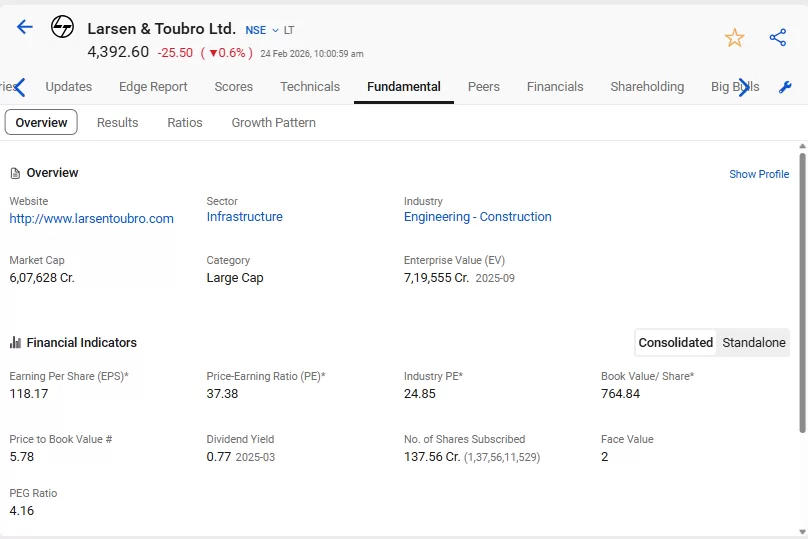
Adani Enterprises Ltd.
Adani Enterprises, through its joint venture AdaniConneX, is developing hyperscale data centre campuses across key digital hubs such as Hyderabad, Noida, Pune, and Navi Mumbai. The group’s strength lies in its integrated infrastructure ecosystem, spanning power generation, renewable energy, transmission, and land aggregation.
Data centres are power-intensive assets, and Adani’s ability to secure long-term renewable energy supply provides a strategic edge. With operational capacity already in place and significant megawatt capacity under development, the platform aims to scale to gigawatt levels over time. Within Adani Enterprises, data centres represent a long-term digital infrastructure growth vertical aligned with AI and cloud expansion.
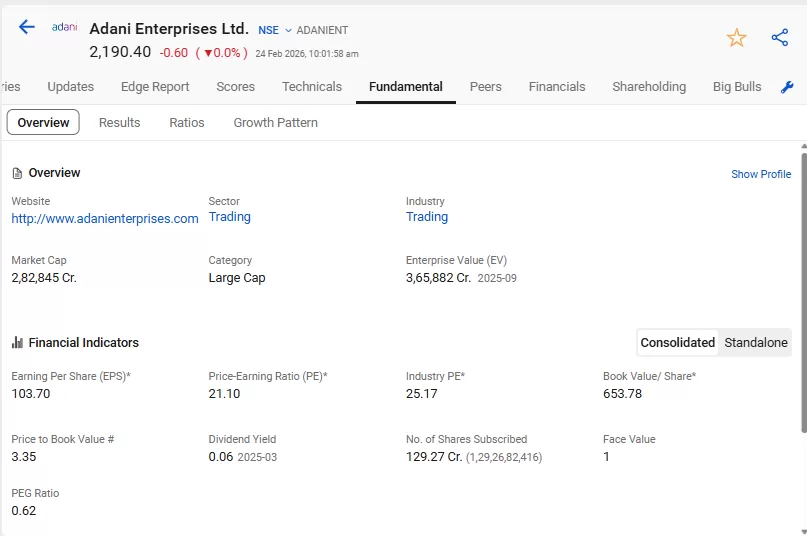
Bharti Airtel Ltd.
Bharti Airtel participates in the data centre segment through its majority-owned subsidiary Nxtra Data. Nxtra operates one of the largest networks of carrier-neutral data centres in India and benefits from Airtel’s telecom backbone and submarine cable connectivity. The strategic advantage here is network integration; combining connectivity with hosting infrastructure enhances service stickiness and enterprise relationships.
With aggressive expansion plans targeting substantial capacity growth over the next few years, Nxtra aims to capture a meaningful share of hyperscaler and enterprise demand. Airtel’s established enterprise customer base further strengthens cross-selling opportunities in the digital infrastructure ecosystem.
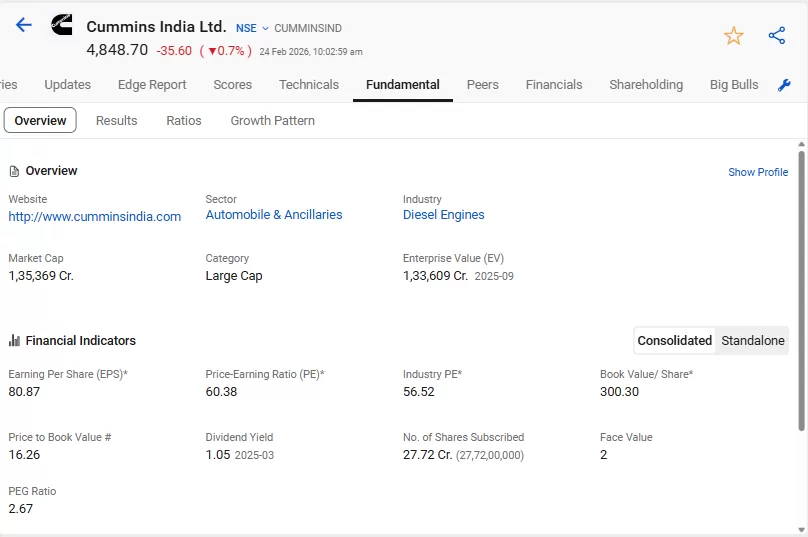
Cummins India Ltd.
Cummins India is a leading provider of backup power solutions, including high-capacity diesel and gas generator sets. Since uninterrupted power is non-negotiable for data centres, backup and redundant power infrastructure form a crucial component of project capex.
Cummins supplies reliable generator systems designed for mission-critical operations, making it an indirect yet important beneficiary of data centre expansion.
As hyperscale campuses scale in megawatt capacity, demand for high-performance backup systems and long-term maintenance contracts is expected to rise.
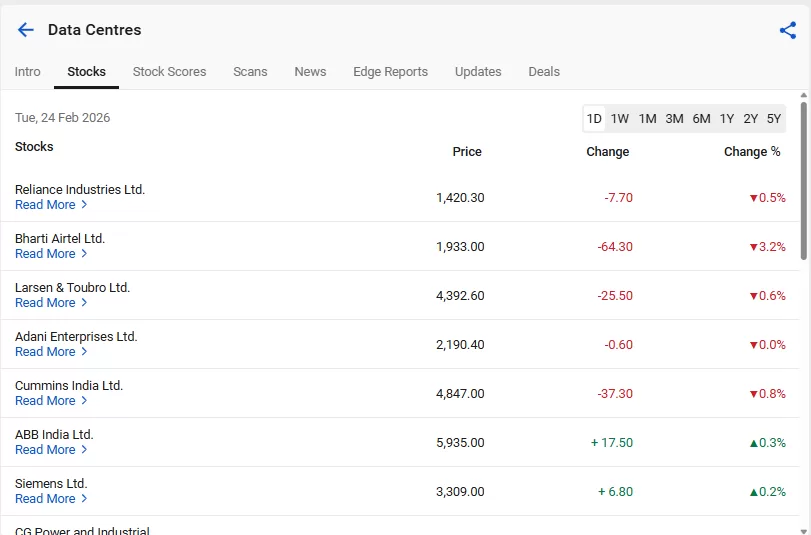
For deeper insights and a structured breakdown of the sector, you can also explore our detailed investment cases on the Data Centre theme available on StockEdge.
Conclusion
As of March 2024, India’s operational capacity stands at 1,074 MW across 163 facilities. This capacity is projected to double to 2 GW by 2026, representing a fierce 26% CAGR.
Looking further out, developers have a pipeline of over 3 GW planned for the next decade, necessitating an estimated US$ 25 billion in capex. The transition from “bricks and mortar” to “bits and power” is no longer a trend; it is a sovereign-backed industrial shift. As India evolves from a data consumer into a global storage and AI hub, the question for the strategist is not whether to participate, but which pathway offers the most resilient exposure to this digital re-rating.
Read: Best Fintech Stocks in India to Invest in 2026
Frequently Asked Questions (FAQs)
1. How do data centres make money?
Data centres earn revenue by leasing rack space and power capacity to enterprises and hyperscalers under long-term contracts, along with additional income from connectivity, managed services, and cloud/GPU workloads.
2. What makes a data centre company fundamentally strong?
Strong location and connectivity, reliable power access (preferably renewable), disciplined capital allocation, and long-term contracts with high-quality clients are key fundamentals.
3. How can investors diversify within the data centre theme?
Investors can diversify across operators, EPC and electrical equipment providers, power solution companies, telecom-integrated players, and cloud or AI infrastructure businesses.
4. Why is the data centre sector considered a long-term investment theme?
Because it is driven by structural trends like AI adoption, cloud migration, 5G expansion, and rising data consumption, making digital infrastructure a permanent economic backbone rather than a cyclical play.