

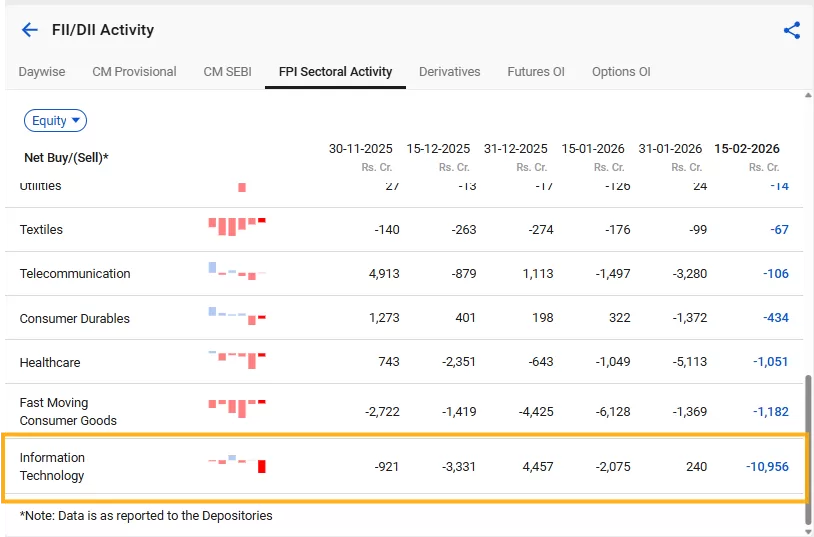
Foreign Institutional Investors (FIIs) have aggressively reduced exposure to Indian IT in early 2026. Net selling has crossed ₹10,000+ crore in a matter of weeks, dragging the Nifty IT into one of its worst February performances in over two decades.
The Big Picture: Scale of the Selloff
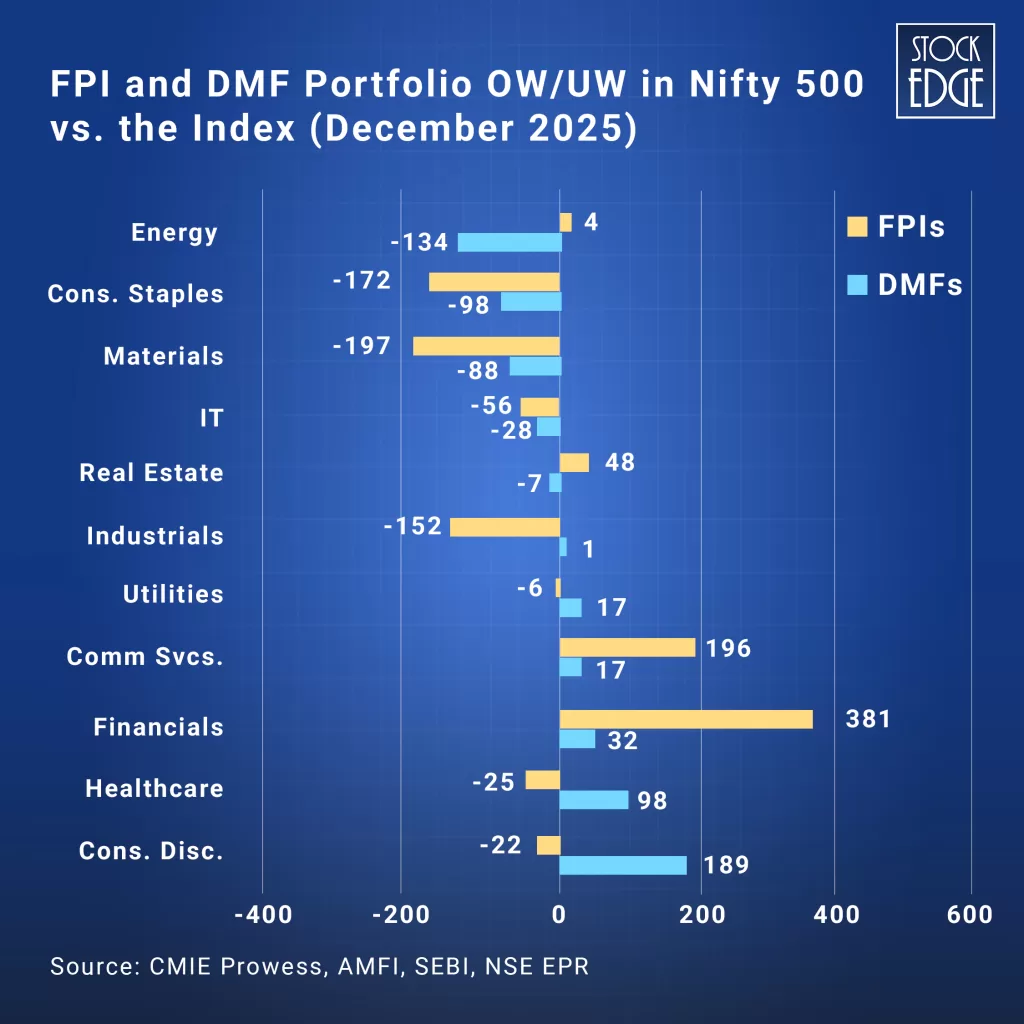
The numbers are staggering. Between January 2024 and December 2025, cumulative FII secondary market outflows exceeded $46 billion, according to exchange data, a scale of selling that has pushed FPI ownership in NSE-listed companies to 16.9%, the lowest in over 15 years (NSE data). India has gone from being a foreign investor darling to the second-largest underweight in global emerging market portfolios, according to HSBC.
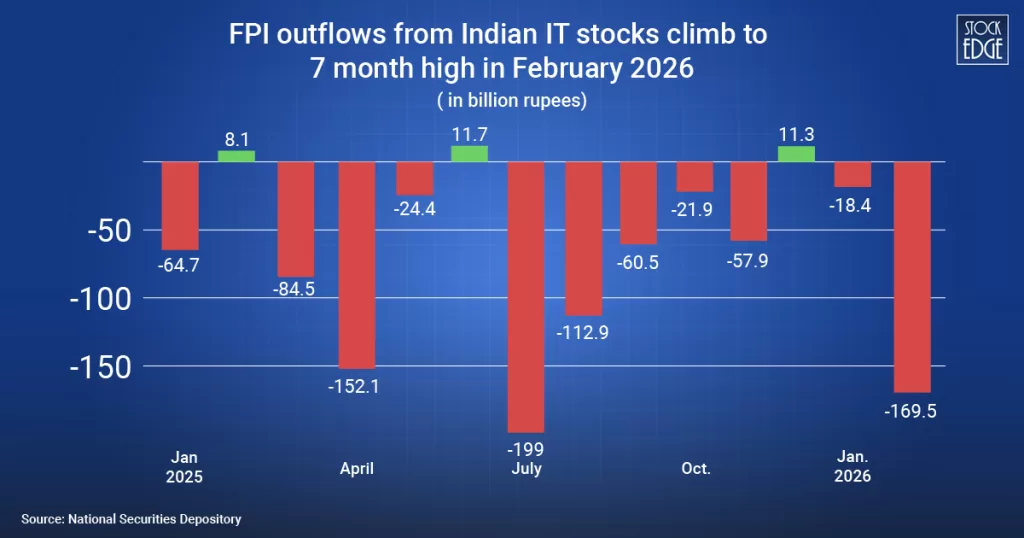
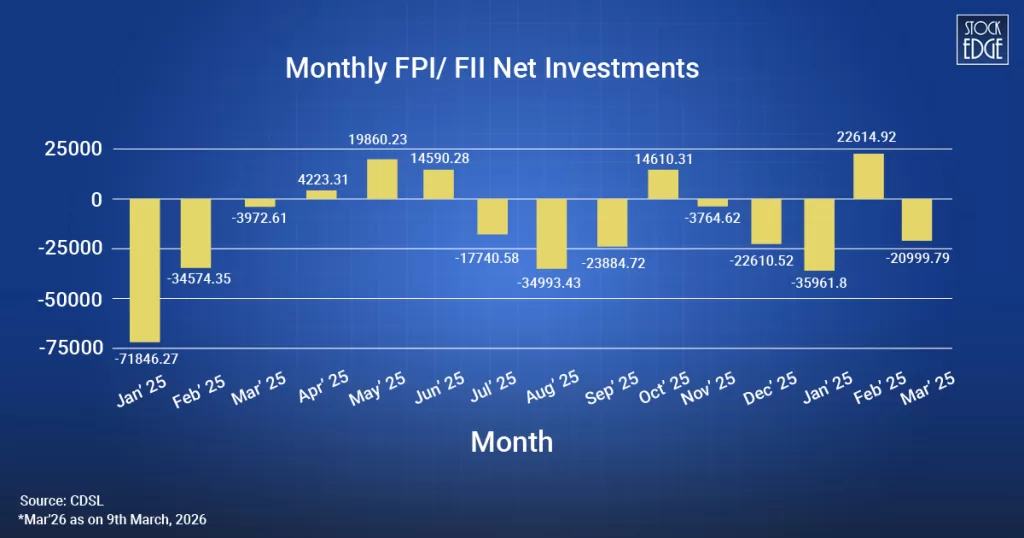
In February 2026 alone, FPIs pulled out ₹16,949 crore from IT stocks, a seven-month high, even as they turned net buyers of ₹22,615 crore overall in Indian equities that month (NSDL data). This divergence signals a specific, structural reassessment of the Indian IT sector’s growth story.
The year 2025 turned out to be the worst on record for foreign investment in the Indian equity market. According to data from CDSL, Foreign Institutional Investors (FIIs) sold equities worth ₹1,94,449.64 crore between January 2025 and 8 March 2026.
AI Disruption Threat
The most powerful and arguably most structural reason driving FPI selling is the fear that generative AI will fundamentally undermine the Indian IT sector’s core business model. For decades, Indian IT firms have built a dominant global position based on labour arbitrage, deploying large armies of skilled engineers to deliver software development, testing, and BPM to multinational clients at a fraction of Western costs.
Generative AI, particularly coding-focused models, threatens to automate precisely these high-volume, repeatable tasks. Investors fear this could compress deal sizes, shrink billing hours, disrupt the traditional staffing pyramid, and erode revenue visibility for firms like TCS, Infosys, HCL Tech, and Wipro.
US Tariffs & Macro Uncertainty
The reinstatement of aggressive US trade tariffs significantly rattled Indian IT stocks. When President Trump announced a 26% tariff on Indian goods, the Nifty IT index plummeted 4.25% in a single session, compared to just 0.35% for the broader Nifty 50.
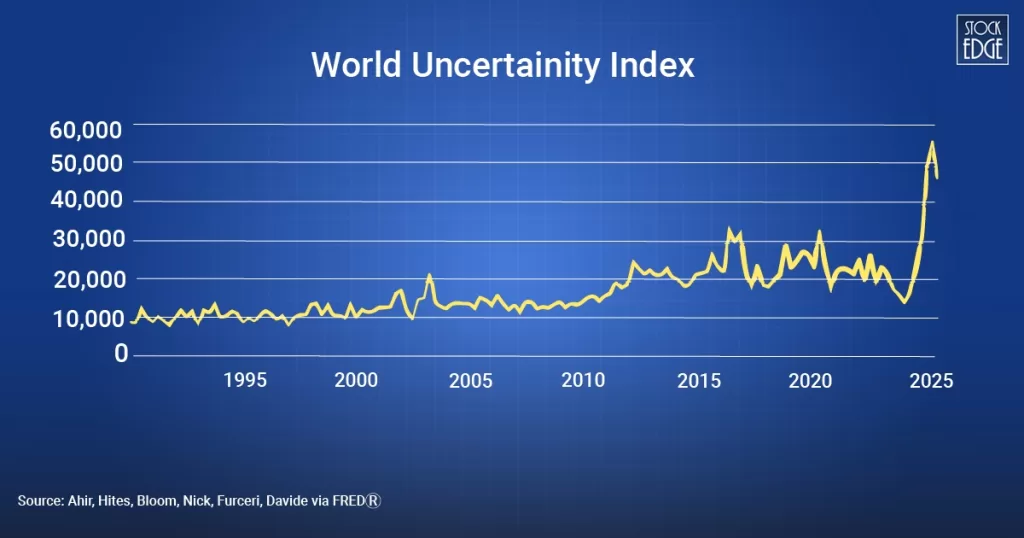
The World Uncertainty Index (WUI) reached a record high of 106,862 in February 2026, surpassing peaks from 9/11, the 2008 financial crisis, and the COVID-19 pandemic. A strengthening U.S. dollar, rupee weakness, and global liquidity tightening make emerging markets like India less attractive for FIIs. Geopolitical tensions (e.g., Middle East, U.S.-Venezuela), high oil prices, and portfolio rebalancing toward developed markets add to outflows.
H-1B Visa Headwinds
In late 2025, the US government announced a $100,000 fee for fresh H-1B visa applications, sending the Nifty IT index down 5.6% over a single week. Major players, including TCS, Infosys, Wipro, and HCL Tech, collectively lost over ₹1.36 lakh crore in market capitalisation in just four days following this announcement.
This policy forces Indian IT firms to either absorb sharply higher visa costs, directly squeezing margins, or accelerate onshore hiring in the US, which reduces the labour cost advantage that underpins their competitive model.
Valuation Derating & Earnings Slowdown
IT stocks trade at stretched multiples relative to modest growth expectations for FY27-28, prompting profit booking despite some strong Q3 results. Muted guidance, margin headwinds, and slower U.S. client decisions have fueled caution, even as domestic IT earnings held up.
What Lies Ahead: Reasons for Cautious Optimism
The picture is not entirely bleak. Several factors suggest the worst of the selling may be behind the sector, though a sharp reversal is unlikely in the near term.
Valuations have corrected significantly. The Nifty IT index’s P/E ratio has now fallen below that of the Nifty 50 benchmark, a rare occurrence historically associated with attractive entry points.
FPI positioning is now deeply underweight. Domestic investors have provided a floor. DIIs have consistently absorbed FPI selling, preventing deeper market dislocations.
The Bottom Line
The foreign investor exodus from Indian IT stocks is not a single-cause phenomenon. It reflects a confluence of structural concerns, AI disruption threatening the labour-arbitrage model, US tariffs and macro uncertainty reducing client spending, H-1B visa policies hiking operating costs, stretched valuations relative to slowing earnings growth, and a global capital rotation toward AI hardware ecosystems in East Asia.
For domestic investors, the silver lining may lie in the significant valuation correction that has now brought sector PE ratios below the broader market, a setup that historically has preceded meaningful recoveries.
The key question is not whether Indian IT survives AI. The question is how long the transition takes, and whether earnings growth resumes before valuations compress further. That answer will determine when the FPI selling finally stops.
Frequently Asked Questions (FAQs)
1. Why are FIIs selling in the Indian market?
Foreign institutional investors are selling in the Indian market due to factors such as high market valuations, rising US interest rates, a stronger US dollar, global economic uncertainty, and portfolio rebalancing toward other attractive markets or sectors.
2. Which IT companies in India have seen the highest FII selling activity?
Major Indian IT companies such as Tata Consultancy Services, Infosys, HCLTech, Wipro, and Tech Mahindra have witnessed notable FII selling due to concerns over slowing global tech spending and pressure on IT services demand.
3. Where can I find daily reports on FII net selling activity?
Daily reports on FII net buying or selling activity can be accessed from official sources like National Securities Depository Limited, National Stock Exchange of India, and Bombay Stock Exchange, as well as analytics platforms like StockEdge.