
The global economy kicked off March 2026 with a sharp geopolitical escalation in West Asia, triggered by the Iran–Israel–US conflict. Crude oil prices surged past US$100/bbl for the first time since 2022, climbing over 40% from pre-crisis levels. Disruptions near the Strait of Hormuz, which handles ~25% of global oil and ~20% of LNG, sparked fears of a prolonged supply shock.
For India, the impact is immediate. With a heavy dependence on imported crude, rising oil prices add pressure on inflation, the current account, and overall market sentiment. Unsurprisingly, Indian equities have also seen a sharp correction, reflecting both global uncertainty and rising input cost concerns.
Yet, beneath this volatility, domestic fundamentals remain relatively strong. Growth continues to hold up, earnings remain resilient, and consistent domestic flows are providing stability to the markets.
In such an environment where global risks are elevated, but India’s structural story remains intact, investors are increasingly looking for stability within equities. This is where large-cap mutual funds come into focus, offering exposure to established market leaders that are better positioned to navigate uncertainty.
In this blog, we explore the top 5 large-cap mutual funds in India based on 10-year returns and how they fit into a long-term investment strategy.
What Are Large-Cap Mutual Funds?
In India, SEBI defines large-cap stocks as the top 100 companies ranked by full market capitalisation. A large-cap mutual fund must invest a minimum of 80% of its assets in these companies at all times.
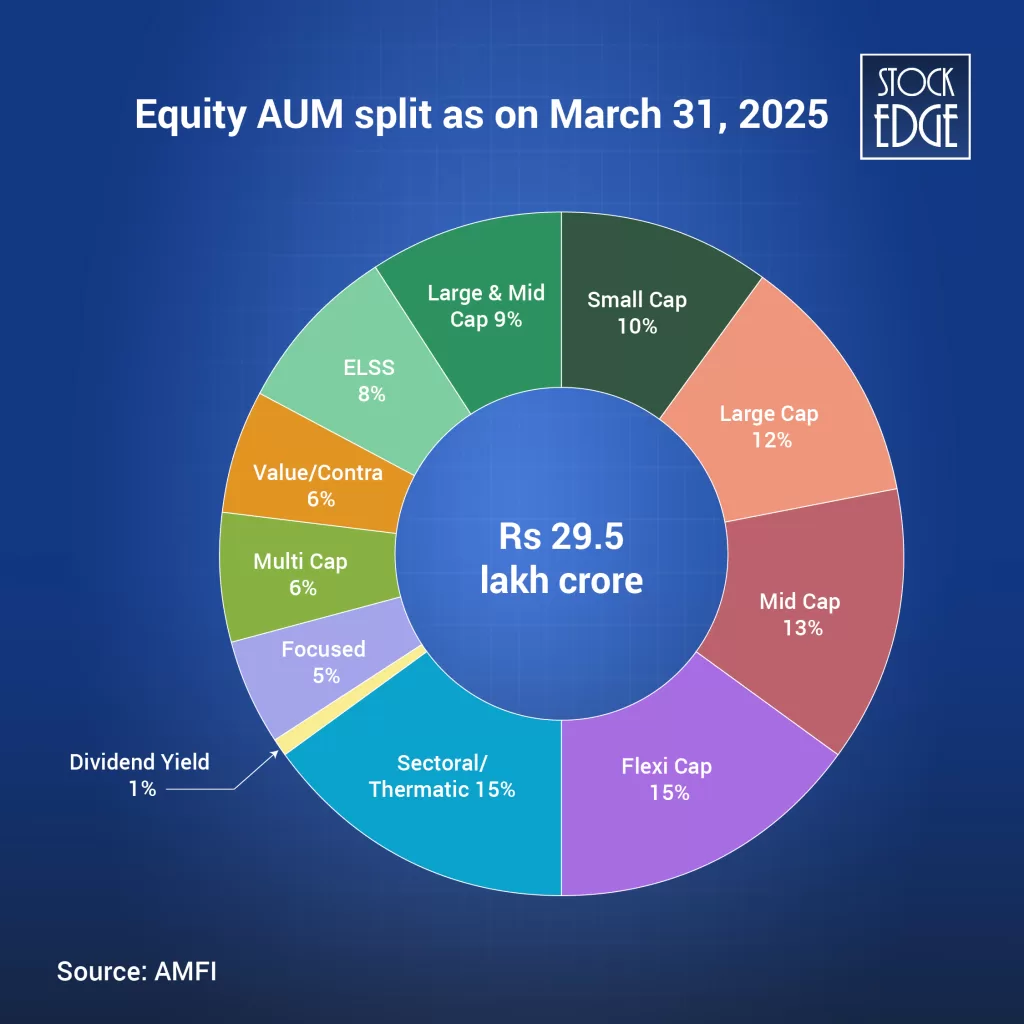
The remaining 20% gives the fund manager some flexibility, typically deployed in cash, short-term instruments, or the occasional mid-cap stock to generate extra returns. As of 31st March, 2025, large-cap funds account for around 12% of the total equity AUM, highlighting their importance as a core category.
Why Choose Large Cap Mutual Funds?
Now the question is, why do you select the large-cap mutual funds?
The question is genuine, but before answering the question, just look at the chart below that shows the returns of large-cap, mid-cap, and small-cap stocks.
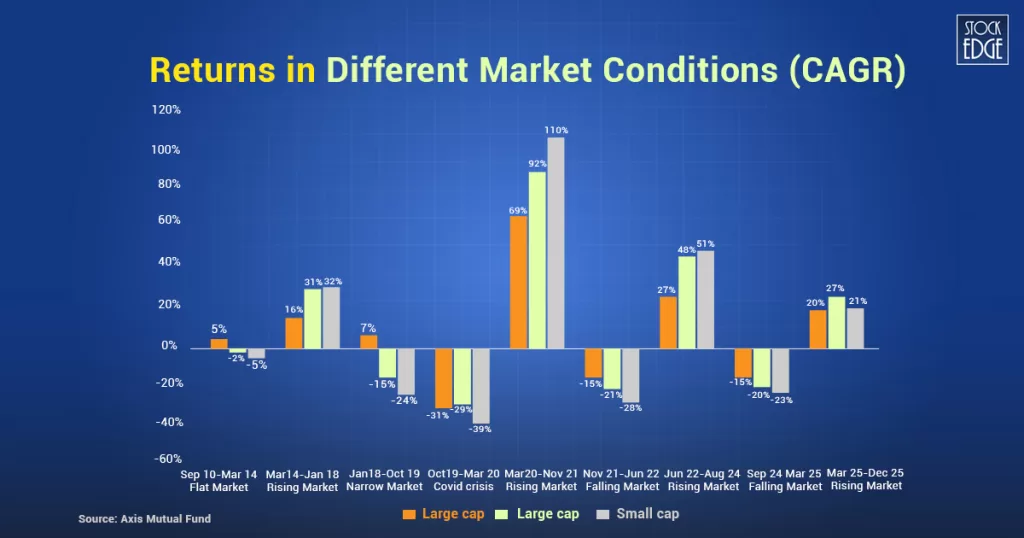
This highlights how different market segments, large caps, mid caps, and small caps, behave across various market cycles. The key takeaway is that performance is not consistent across phases, and each category reacts differently depending on whether markets are rising, falling, or moving sideways.
One of the biggest advantages of large-cap mutual funds is their ability to navigate different market cycles more smoothly compared to mid and small-cap segments. Markets do not move in a straight line; they go through phases of rallies, corrections, and consolidation. In such an environment, stability becomes as important as returns.
During sideways or uncertain markets, large-cap stocks tend to hold up better. Their strong business models, consistent earnings, and institutional backing help them remain relatively stable, while mid and small caps often struggle due to lower visibility and higher volatility.
How To Select Large-Cap Mutual Funds?
Now, let’s understand how to select a large-cap mutual fund. Choosing the right mutual fund is not about picking the one with the highest recent returns. It’s about selecting a fund that aligns with your goals, risk appetite, and investment approach. Here are the key factors you should consider:
- Compare with benchmark and peers: A good fund should not only generate returns but also outperform its benchmark and stay competitive within its category over time.
- Check consistency of performance: Instead of focusing on one-year returns, evaluate how the fund has performed across multiple market cycles. Consistency matters more than short-term outperformance.
- Look at the expense ratio: Costs directly impact your returns. Even a small difference in expense ratio can significantly affect long-term wealth creation.
- Evaluate risk-adjusted returns: Metrics like Sharpe ratio, beta, and standard deviation help you understand whether the fund is delivering adequate returns for the risk it is taking.
- Review portfolio composition: Understanding where the fund invests, sectors, stocks, or asset classes, clarifies the fund’s strategy and diversification.
- Consider the fund manager’s track record: A consistent and experienced fund manager adds credibility to the fund’s long-term performance.
- Use the fact sheet as a regular check: You don’t need to track your fund daily, but reviewing it periodically helps you stay informed and aligned with your investment goals.
Risks of Investing in Large-Cap Mutual Funds
While large-cap mutual funds are considered relatively stable, they are not risk-free. Investors should be aware of certain limitations before allocating capital.
- Moderate return potential: Large-cap companies are already well-established, so the scope for high growth may be limited compared to mid and small caps.
- Limited alpha generation: Many large-cap funds closely track their benchmark, making it difficult to consistently outperform the index.
- Market risk: Large-cap funds are still exposed to overall market movements and can decline during corrections.
- Fund manager risk: Performance depends on the fund manager’s decisions, strategy, and consistency over time.
- Sector concentration risk: High exposure to specific sectors like banking or IT can impact returns if those sectors underperform.
- Opportunity cost: In strong bull markets, large-cap funds may underperform more aggressive segments like mid and small caps.
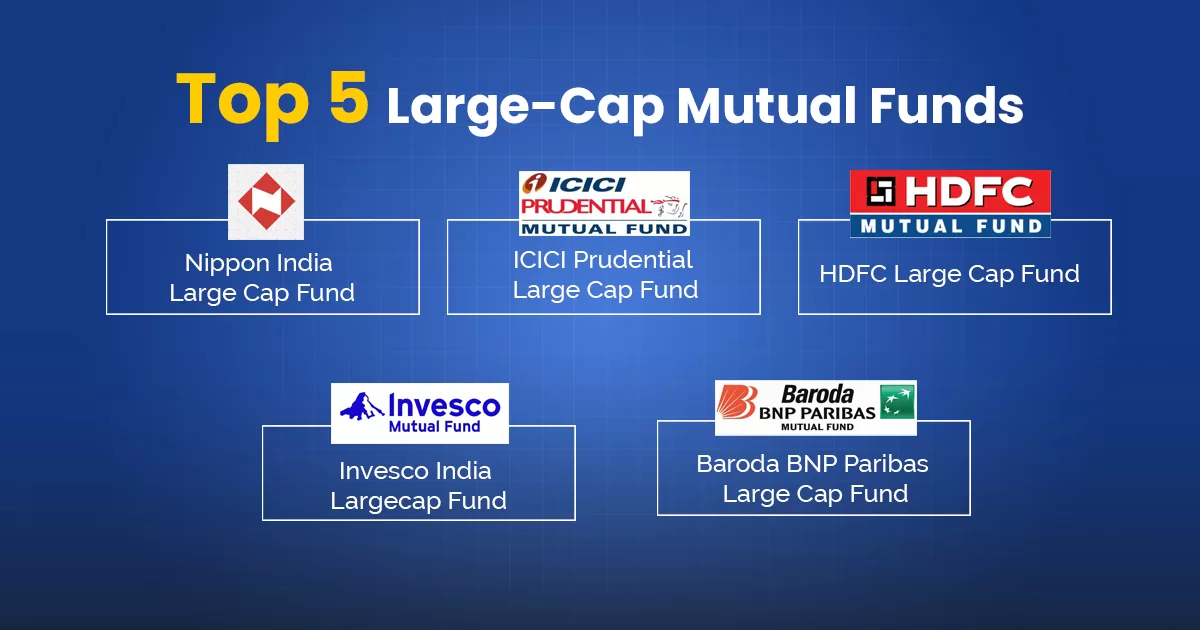
Top 5 Large Cap Mutual Funds in India Based on 5-Year Returns
Nippon India Large Cap
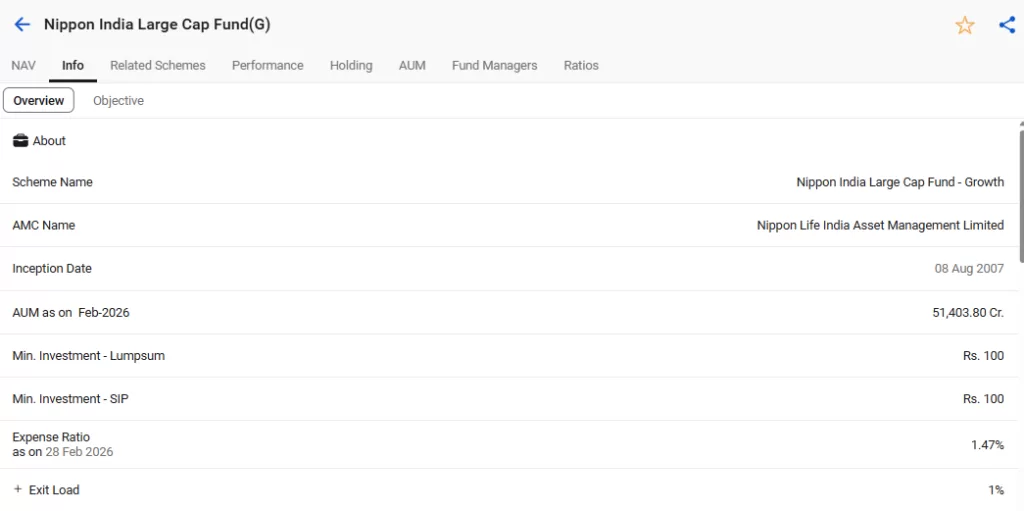
Nippon India Large Cap Fund (Growth) is a predominantly large‑cap equity scheme with a very high AUM of around ₹51,400 crore. This fund is managed by Sailesh Raj Bhan and Assistant Fund Manager Bhavik Dave.
The investment strategy focuses on leaders or potential leaders with established business models, sustainable free cash flows, and strong financials to provide stability and liquidity to the portfolio.
The portfolio is heavily weighted toward Large Cap stocks (84.87%), with secondary allocations to Mid Cap (12.31%) and Small Cap (2.82%) as of February 2026.
While the fund seeks consistent returns, its Riskometer and that of its benchmark both indicate that the risk level is Very High. Additionally, while there is no entry load, an exit load of 1% applies if units are redeemed or switched out within seven days of allotment.
ICICI Pru Large Cap Fund
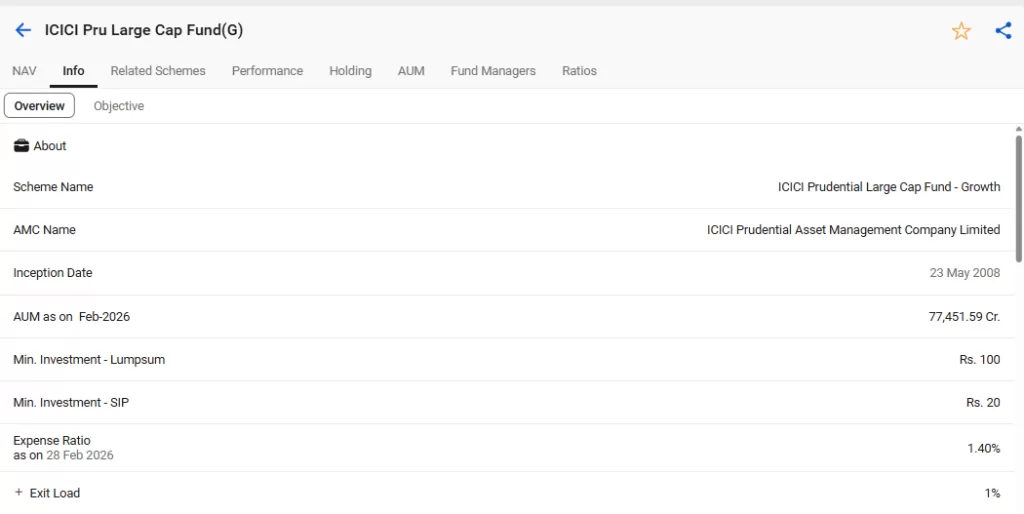
The ICICI Prudential Large Cap Fund (formerly known as ICICI Prudential Bluechip Fund) is an open-ended equity scheme that primarily invests in large-cap stocks. s of February 2026, the fund manages a significant corpus with a Closing AUM of Rs. 77,451.59 crores.
The fund is currently managed by a team including Sankaran Naren, Vaibhav Dusad, and Sharmila D’silva.
The fund aims to create wealth over the long term by investing primarily in the top 100 companies by market capitalization. The fund also maintains a small portion of its assets in debt holdings and treasury bills for liquidity.
HDFC Large Cap Fund
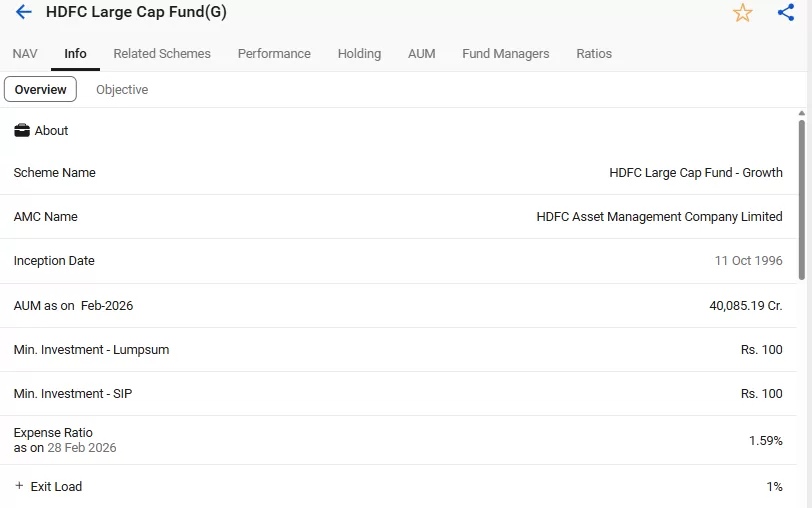
The HDFC Large Cap Fund is an open-ended equity scheme that focuses on long-term capital appreciation by investing at least 80% of its assets in large-cap companies. As of February 2026, the fund manages a significant corpus of INR 37,659.18 Cr.
The fund is managed by Mr. Rahul Baijal since July 2022. The strategy centers on building a well-diversified portfolio of high-quality, sustainable businesses selected from the top 100 companies by market capitalization. While predominantly large-cap (86.79%), the fund maintains minor flexibility with a 13.21% exposure to mid-cap stocks.
Invesco India Largecap Fund
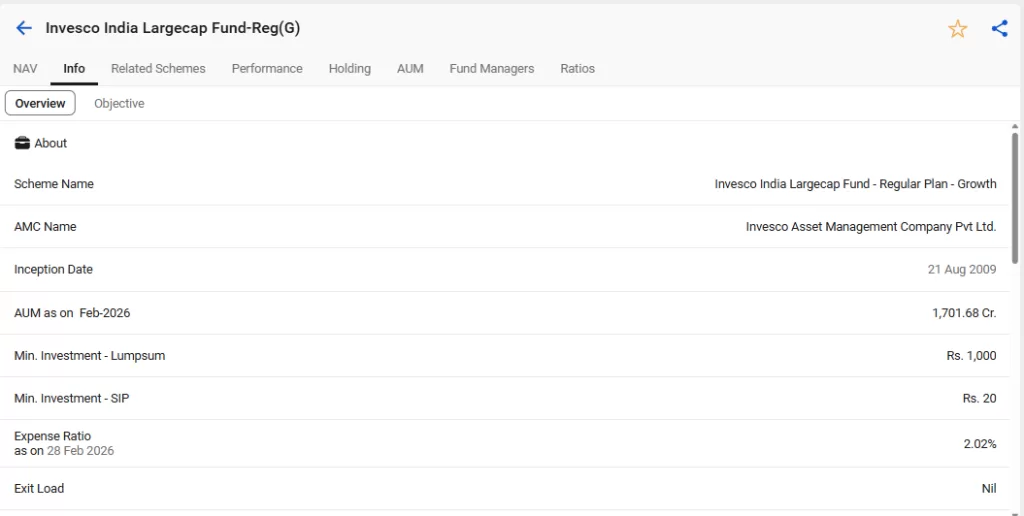
The Invesco India Largecap Fund is an open-ended equity scheme designed for long-term capital appreciation by investing at least 80% of its net assets in large-cap companies.
As of February 28, 2026, the fund maintains a fully invested approach with 83.58% of its portfolio in large-cap stocks, while also holding tactical exposures of 8.49% in mid-caps and 7.93% in small-caps to drive incremental returns.
Performance-wise, the scheme has demonstrated resilience, delivering a 3-year CAGR of 15.51% and a 5-year CAGR of 12.4%, outperforming its Nifty 100 TRI benchmark in both periods. Despite this track record, both the scheme and its benchmark carry a “Very High” risk rating, reflecting the inherent volatility of equity markets.
Baroda BNP Paribas Large Cap Fund
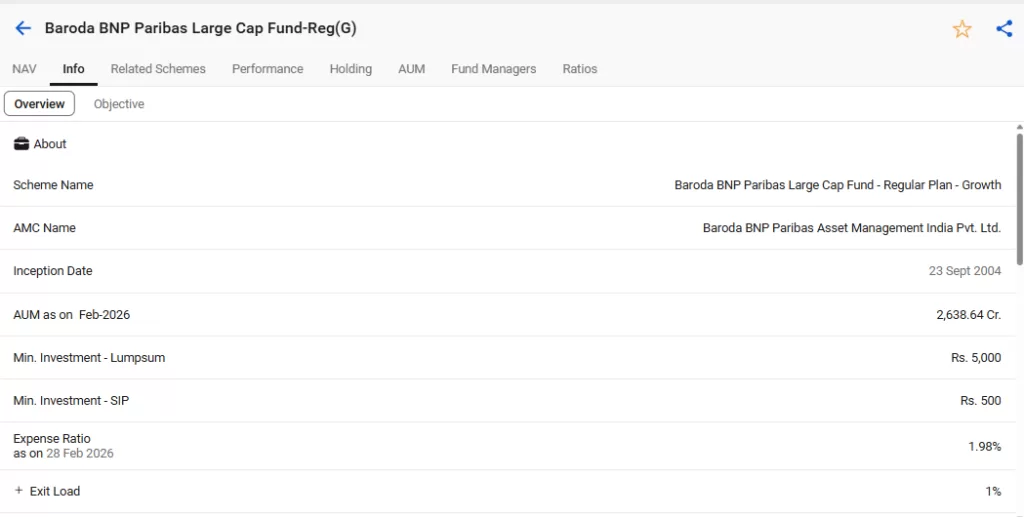
The Baroda BNP Paribas Large Cap Fund is an open-ended equity scheme that focuses on investing in blue-chip companies and market leaders with established businesses.
Established on September 23, 2004, the fund is currently managed by Jitendra Sriram and Kushant Arora, who oversee an Assets Under Management (AUM) of ₹2,638.64 Crores as of February 28, 2026.
The fund’s investment style is categorized as “Large Cap Growth,” with 88.77% of its net assets allocated to large-cap stocks and 11.23% to mid-caps.
In terms of performance, the fund has a long track record of wealth creation, delivering a 15% CAGR since inception. From a risk perspective, the fund carries a “Very High” risk rating, with a standard deviation of 11.83% and a beta of 0.97, indicating it is slightly less volatile than the broader market.
Conclusion
Before investing in any mutual fund, you have to understand yourself. Your investment horizon, risk tolerance, and financial goals should guide every decision you make. Without this clarity, even the best-performing fund may not be the right fit for you.
Large-cap mutual funds are ideal for investors looking for stable, long-term equity exposure with relatively lower volatility.
While they may not deliver the highest returns in bull markets, they provide consistent compounding and better downside protection, making them a core part of any well-balanced portfolio. The table below presents the returns (%) of the top 5 large-cap mutual funds across different time horizons, compared with the benchmark BSE 100 TRI:
| Return Over Time (%) | |||||
| Fund Name | 3M | 6M | 1Y | 3Y | 5Y |
| Nippon India Large Cap Fund | -11.05 | -8.01 | -0.63 | 16.48 | 15.82 |
| ICICI Prudential Large Cap Fund | -11.31 | -7.24 | -1.17 | 15.4 | 13.91 |
| HDFC Large Cap Fund | -11.11 | -6.94 | -3.24 | 13.08 | 12.95 |
| Invesco India Largecap Fund | -11.63 | -8.32 | -0.77 | 15.14 | 12.41 |
| Baroda BNP Paribas Large Cap Fund | -9.99 | -6.01 | -2.27 | 13.82 | 11.73 |
| BSE 100 TRI | -12.02 | -6.98 | -1.85 | 12.99 | 11.66 |
While short-term returns (3M, 6M, 1Y) reflect market volatility, most large-cap funds have outperformed the BSE 100 TRI over the longer term (3Y and 5Y), highlighting their ability to deliver consistent compounding over time.
Frequently Asked Questions (FAQs)
1. What is the average return of Large Cap Mutual Funds in India?
Large-cap funds have historically delivered around 12%-15% annualised returns over the long term, depending on market conditions.
2. Are Large Cap Mutual Funds better than index funds?
It depends on performance and cost. If a fund is able to consistently outperform its benchmark over time, active funds can add value. However, if it struggles to beat the index, then index funds often become a better choice due to their lower costs and more predictable returns.