

Table of Contents
Jio Platforms’ record ₹30,213 crore IPO is a fresh issue at a price band of ₹1,065 to ₹1,119, with most of the proceeds going to repay borrowings of Reliance Jio Infocomm. This guide breaks down what the business does, how revenue, EBITDA and profit have grown from FY24 to Q1 FY27, and what the price band implies at about 34 times earnings and 3 times book value. It also compares Jio with Bharti Airtel and Vodafone Idea and sets out the key risks, from tariff pressure and heavy capex to dependence on the Reliance Group.
India’s Largest IPO Opens for Bids
India’s IPO market is set for a major event as Jio Platforms Limited opens its much-awaited public issue. Backed by Reliance Industries Limited, Jio has grown from a telecom business into a broader digital ecosystem spanning mobile connectivity, 5G, home broadband and enterprise technology services. With millions of users relying on its network every day, the company has built a significant presence in India’s digital economy.
The Jio IPO is scheduled to open for subscription from 21 October to 23 October 2026, with an IPO price band of ₹1,065 to ₹1,119 per share. At the upper end of the price band, the issue is expected to raise approximately ₹30,213 crore, making it India’s largest IPO to date. The issue is a fresh share offering, with proceeds largely intended to repay borrowings of Reliance Jio Infocomm Limited, along with meeting general corporate requirements.
But the scale of the offering is only one part of the story. For investors, the bigger questions are how Jio Platforms makes money, whether its financial performance justifies the proposed Jio IPO valuation, and how it plans to turn its large customer base into sustainable growth.
In this blog, we break down the Jio Platforms IPO, its financial performance, valuation and key risks to help investors understand what lies behind the numbers before making an investment decision.
Jio IPO Details at a Glance: Dates, Price Band and Lot Size
The Jio Platforms IPO is a fresh issue of up to 27 crore equity shares, with no offer for sale (OFS). Here are the key details investors should know before applying.
| IPO detail | Information |
|---|---|
| IPO opening date | 21 October 2026 |
| IPO closing date | 23 October 2026 |
| Price band | ₹1,065 to ₹1,119 per share |
| Face value | ₹10 per share |
| Issue size | Up to ₹30,213 crore |
| Lot size | 12 shares |
| Minimum investment | ₹12,780 at the lower price band; ₹13,428 at the upper band |
| Allotment date | 26 October 2026 |
| Tentative listing date | 28 October 2026 |
| Listing exchanges | BSE and NSE |
Where will the Jio IPO money go?
- Debt repayment: Up to ₹27,500 crore is earmarked for prepayment of borrowings of Reliance Jio Infocomm Limited.
- General corporate purposes: The remaining proceeds will be used for general corporate requirements and issue-related expenses.
What Do Jio Platforms Do?
Jio Platforms Limited (JPL) is a technology company under Reliance Industries Limited (RIL). While Jio is widely known for its mobile network, its business extends beyond telecom to broadband, digital applications, enterprise solutions and emerging technologies. Understanding this business is central to judging the Jio IPO.
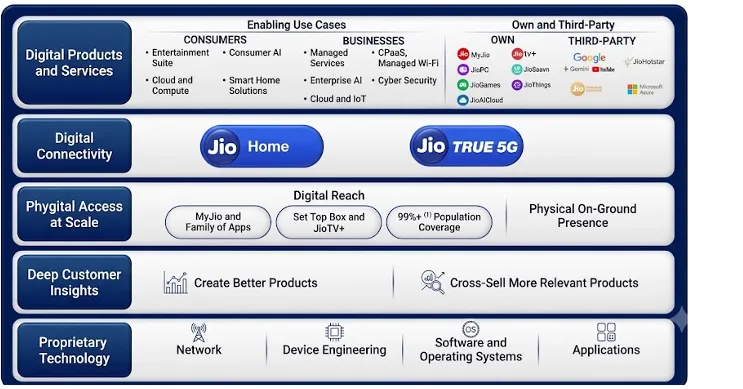
Its business can be understood through four key areas:
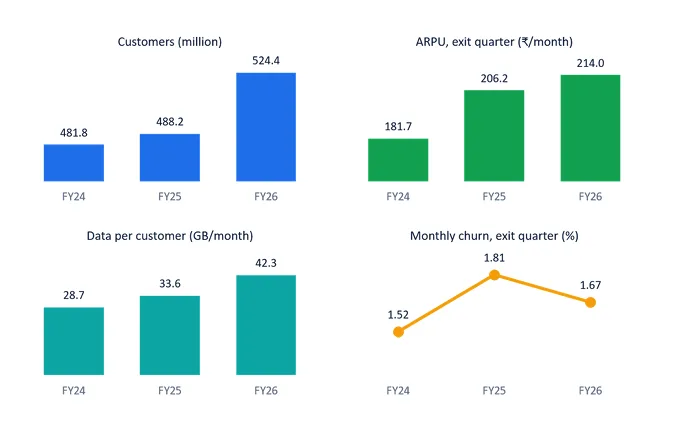
- Mobile connectivity (4G and 5G): Through its subsidiary, Reliance Jio Infocomm Limited (RJIL), the company provides mobile data and voice services. As of March 2026, RJIL served 524.4 million customers, including 268.5 million 5G users.
- Home broadband: JioFiber and JioAirFiber provide internet connectivity to homes and businesses, alongside connected-home and entertainment services. Jio had 27.1 million fixed broadband subscribers as of March 2026.
- Digital services and applications: Its offerings span entertainment, music streaming, gaming, cloud storage and computing, smart-home solutions and AI-based products. These services help expand the ecosystem beyond basic connectivity.
- Enterprise technology solutions: Jio provides businesses with cloud services, private 5G networks, Internet of Things (IoT) solutions, cybersecurity and managed connectivity. It also develops technology platforms for telecom operators and enterprise customers.
How does its business model work?
At its core, Jio uses connectivity to build customer relationships and then offers additional digital services to consumers and businesses. Its large subscriber base, network infrastructure and in-house technology provide opportunities to increase customer spending and expand into new services.
However, Jio Platforms’ business is not the same as a standalone telecom operator. JPL is the parent technology platform, while RJIL operates the telecom connectivity business. This distinction matters when examining the Jio IPO financial statements and valuation.
What the Fresh Issue Means for Reliance’s Stake
Unlike an Offer for Sale (OFS), where existing shareholders sell their shares, the Jio IPO is structured as a fresh issue of up to 27 crore equity shares. The money raised will go to the company, primarily to repay borrowings of Reliance Jio Infocomm Limited (RJIL).
Here is what this means for Reliance Industries Limited (RIL) and other existing shareholders:
- Reliance retains its existing shares: RIL is not selling its shares through the Jio IPO. Its holding of approximately 593.78 crore shares remains unchanged.
- Ownership percentage decreases: Since new shares are issued, the total number of outstanding shares increases. As a result, RIL’s percentage stake will fall from 66.43% before the issue, even though it does not sell any shares.
- Other existing investors are also diluted: Investors such as Meta and Google will see their ownership percentages decrease proportionately, assuming they do not acquire additional shares.
Jio Platforms Financials: Revenue, EBITDA and Profit
Jio Platforms has recorded steady growth in revenue and profitability over the last three financial years. Its Q1 FY27 results also show continued growth in operating revenue, EBITDA and profit compared with the same quarter last year. These Jio Platforms financials form the basis for the proposed Jio IPO valuation.
Financial performance at a glance (₹ crore, except EBITDA and PAT margins)
| Financial metric | FY24 | FY25 | FY26 | Q1 FY27 |
|---|---|---|---|---|
| Revenue from operations | 1,09,558 | 1,28,218 | 1,46,885 | 39,173 |
| EBITDA | 54,959 | 64,170 | 76,255 | 20,865 |
| EBITDA margin | 50.16% | 50.05% | 51.91% | 53.30% |
| Profit after tax (PAT)* | 21,423 | 26,109 | 30,049 | 7,764 |
| PAT margin* | 19.55% | 20.36% | 20.46% | 19.82% |
What do the numbers tell us?
- Revenue growth: Revenue from operations increased from ₹1.10 lakh crore in FY24 to ₹1.47 lakh crore in FY26, reflecting an expansion of around 34% over two years.
- Higher operating earnings: EBITDA rose from ₹54,959 crore in FY24 to ₹76,255 crore in FY26. The EBITDA margin also improved to 51.91% in FY26, indicating stronger operating profitability.
- Continued growth in Q1 FY27: Revenue from operations increased 11.8% year-on-year to ₹39,173 crore, while EBITDA grew 15.1% to ₹20,865 crore. EBITDA margin reached 53.3%, up 150 basis points from Q1 FY26.
- Profit continued to rise: Q1 FY27 PAT was ₹7,764 crore, up 9.2% year-on-year. However, higher depreciation and finance costs partly offset the increase in EBITDA.
Overall, the financials show that Jio Platforms has grown its revenue base while maintaining EBITDA margins above 50%. The Q1 FY27 results provide a more recent snapshot of that performance, although one quarter alone cannot establish how the full financial year will unfold.
Jio IPO Valuation: What the IPO Price Band Implies
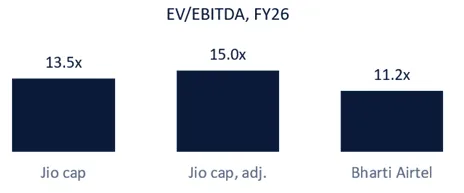
Jio Platforms has set its IPO price band at ₹1,065 to ₹1,119 per share, implying a valuation of approximately ₹10.3 lakh crore at the upper end. But what does this price mean when compared with the company’s earnings and net worth?
- Price-to-Earnings (P/E) Ratio: Based on FY26 profit attributable to owners of ₹30,064 crore, the upper-end valuation implies a P/E of approximately 34.3 times earnings. In simple terms, investors are paying around ₹34 for every ₹1 of annual earnings. This calculation uses the approximate market capitalisation and FY26 earnings; the final multiple can vary with the final issue price.
- Price-to-Book (P/B) Ratio: Jio Platforms reported a net asset value (NAV) of ₹373.66 per share as of March 31, 2026. Comparing this with the upper price band of ₹1,119 gives a P/B ratio of approximately 3 times. This means the Jio IPO price is about three times the company’s reported net asset value per share.
- Comparison with listed peers: The RHP reports a FY26 P/E ratio of 40.71 times for Bharti Airtel and 3.99 times for Vodafone Idea, based on their market prices as of October 13, 2026. Jio’s implied P/E appears lower than Airtel’s, but the comparison should be interpreted carefully because the companies differ in profitability, business mix, financial position and growth prospects.
Competitor Analysis
Jio Platforms competes with established telecom operators, particularly Bharti Airtel and Vodafone Idea. These companies provide useful benchmarks for comparing financial performance and valuation.
- Bharti Airtel: Airtel reported higher revenue and EBITDA margin than Jio Platforms in FY26. It serves as an important benchmark for assessing Jio’s profitability and market position.
- Vodafone Idea: Vodafone Idea reported lower revenue and EBITDA margin than Jio Platforms. Its financial position and profitability differ significantly, so its valuation should be interpreted carefully.
- Jio Platforms: Jio combines telecom connectivity with digital services and a large subscriber base. Its revenue growth and profitability are key factors investors may consider when evaluating its IPO valuation.
| Particulars | Units | The Company | Bharti Airtel (Consolidated) | Vodafone Idea (Consolidated) |
|---|---|---|---|---|
| Total Customer Base | Million | 524.4 | 666 | 192.8 |
| Net Customer Addition | Million | 36.2 | 75.5 | -5.4 |
| ARPU (Exit Quarter) | ₹/month | 214 | 257.2 (India Mobile) / 229.3 (Africa) | 174 |
| Data Traffic | Billion GB | 241.4 | 101.3 (India Mobile) + 8.4 (Africa) | 28.9 |
| Monthly Data Consumption per Customer | GB/month | 42.3 | 31.4 (India Mobile) / 9.8 (Africa) | 20.2 |
| Monthly Churn (Exit Quarter) | % | 1.67% | 2.43% (India Mobile) / 4.34% (Africa) | 3.90% |
| PAT Margin | % | 20.46% | 16.03% | 77.00% |
Key Risks Before You Apply: Jio IPO Risks
Jio Platforms operates at a large scale, but its growth prospects come with risks that investors should consider before applying for the Jio IPO. The main Jio IPO risks are listed below.
- Competition and Tariff Pressure: Jio faces competition from Bharti Airtel and Vodafone Idea. Price wars or delays in tariff hikes could limit average revenue per user (ARPU) growth and put pressure on margins.
- Regulatory and Legal Risks: The telecom business is subject to licence fees, spectrum-related payments and regulatory requirements. Adverse legal or tax outcomes could increase costs and affect cash flows.
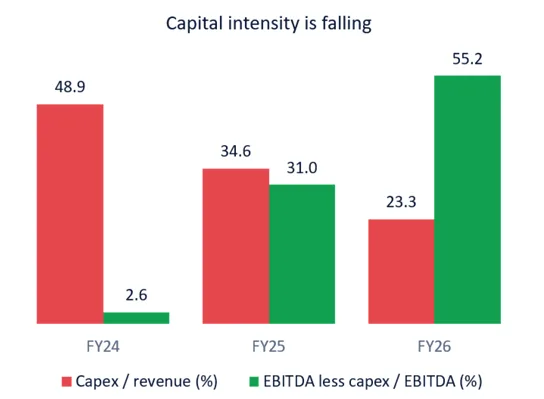
- High Capital Expenditure: Network expansion, 5G infrastructure, broadband services and investments in areas such as AI and data centres require substantial spending. If these investments do not generate returns as expected, profitability and free cash flow could come under pressure.
- Debt and Foreign Exchange Exposure: Spectrum-related obligations and foreign-currency borrowings create financial commitments. Higher interest costs or adverse currency movements could affect the company’s financial position.
- Dependence on the Reliance Group: Jio Platforms operates within the broader Reliance ecosystem and has related-party arrangements. Investors should review these transactions and understand how the group structure may affect its operations and financial decisions.
- Execution Risks in New Businesses: Expansion into enterprise cloud, AI and other digital services offers growth opportunities, but these businesses may take time to scale and become meaningful contributors to profits.
Conclusion
The Jio Platforms IPO offers investors an opportunity to participate in a business that combines telecom connectivity with digital services and a large customer base. Its FY24 to FY26 Jio Platforms financials show growth in revenue and profitability, while the Q1 FY27 results indicate that operating earnings have continued to grow.
However, the company’s scale and financial performance should be considered alongside its valuation, capital expenditure requirements, competition and other Jio IPO risks disclosed in the Red Herring Prospectus.
Before applying, investors should review the IPO price band, understand the company’s financials, assess whether the Jio IPO valuation fits their investment objectives and consider their own risk tolerance. A strong business does not automatically make every IPO price attractive, and listing gains are never guaranteed.
The final decision should depend on your investment horizon, financial goals and assessment of the risks, not just the popularity of the company or expectations around its listing.
FAQs
Q1. What is the Jio Platforms IPO price band?
The Jio IPO price band is ₹1,065 to ₹1,119 per share.
Q2. Is the Jio IPO an offer for sale?
No. It is a fresh issue, with proceeds primarily intended to repay borrowings of Reliance Jio Infocomm Limited.
Q3. What is the Jio IPO lot size and minimum investment?
The lot size is 12 shares. The minimum investment is ₹12,780 at the lower price band and ₹13,428 at the upper price band.
Q4. When is the Jio IPO allotment and listing date?
The lot size is 12 shares. The minimum investment is ₹12,780 at the lower price band and ₹13,428 at the upper price band.
Q5. When is the Jio IPO allotment and listing date?
Allotment is tentatively scheduled for October 26, 2026, and listing for October 28, 2026, subject to official confirmation.
Q6. What should investors check before applying for the Jio IPO?
Review the company’s financial performance, valuation, disclosed risks and IPO details, and consider your investment goals and risk tolerance.