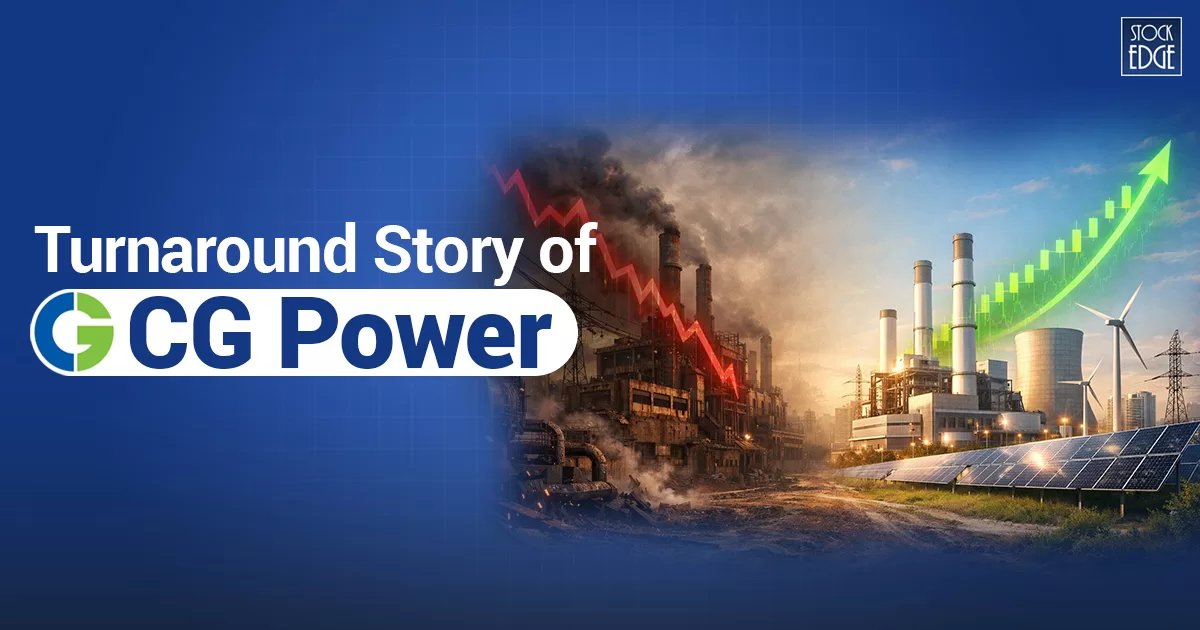

In 2019, one of India’s oldest electrical engineering companies, a name that has been powering factories, railways, and transformers since 1937, is suddenly all over the news. And not for good reasons.
Yes, you are guessing right!
CG Power and Industrial Solution
The board discovered that nearly ₹3,000 crore had been diverted through unauthorized transactions. Auditors resigned; investigations by SEBI, the Serious Fraud Investigation Office, and the Central Bureau of Investigation began; and the chairman was removed.
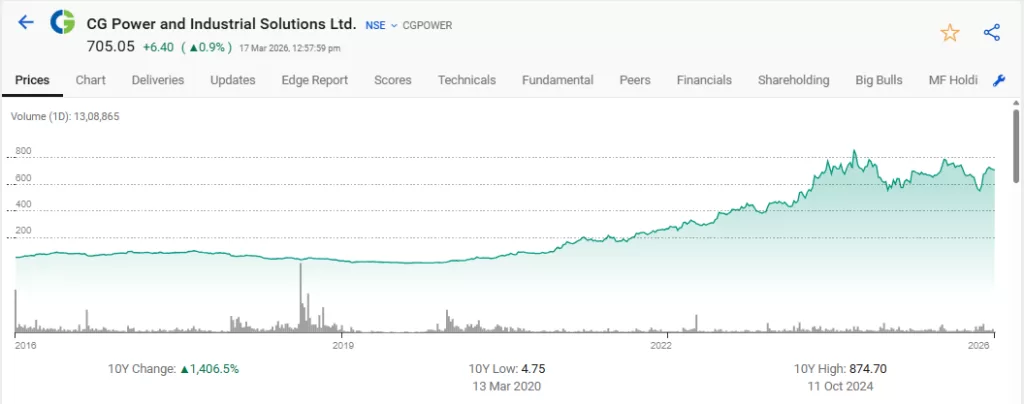
Check out the price on StockEdge
How Did a Company This Old Fall This Hard?
The third-generation promoter of CG Power, Gautam Thapar, took the company on an aggressive global acquisition spree, buying assets in Europe, stretching the balance sheet, and apparently helping himself to company funds in the process.
Over ₹2,358 crore in advances and loans were sitting outside the company. Not with customers, not with business partners, but with promoter-affiliated entities and connected parties.
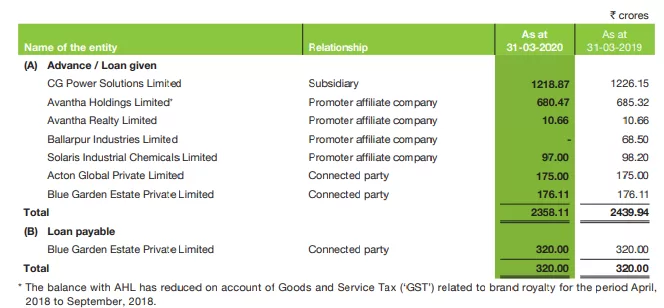
This type of transaction is also known as Related Party Transactions.
The company had no working capital left, even to pay interest on its loans. A company built over eight decades had been hollowed out from the inside.
Then Came the Move Nobody Expected
In mid-2020, Tube Investments of India, part of the Murugappa Group, a conglomerate widely respected for its culture of strong governance, decided to bet on a broken company.
They invested ₹700 crore for a 56.29% stake in CG Power. At the time, the accounts were still being restated, meaning nobody fully knew how deep the damage went. Most serious investors had already walked away. Murugappa walked in.
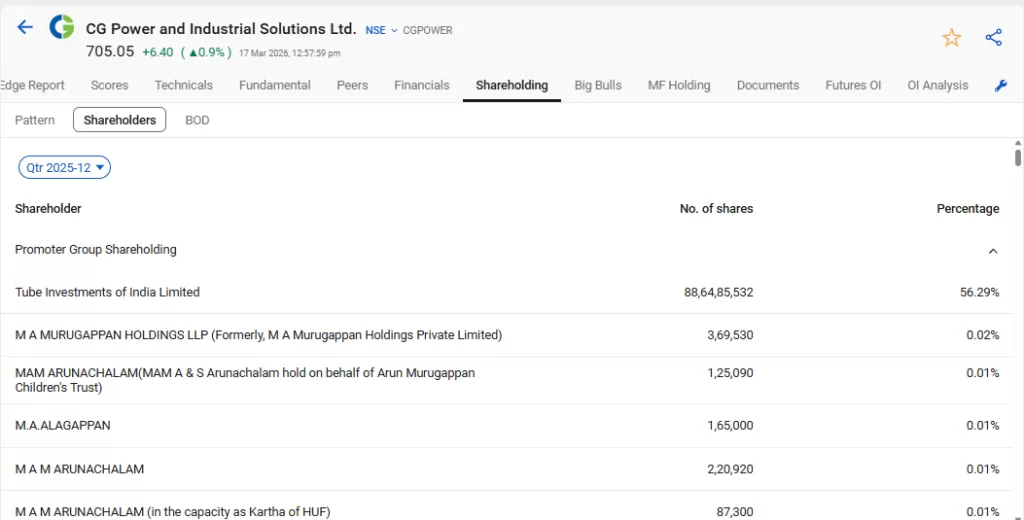
Check out the Shareholding Pattern on StockEdge
Their core thesis was clear; the underlying business was fundamentally sound. CG Power had real products, real customers, and real manufacturing capability. The rot was in the ownership, not in the company itself.
The Turnaround: Slow, Steady, and Deliberately Boring
There was no single dramatic moment. No big announcement. No flashy rebranding.
Vellayan Subbiah took on the Chairman’s role and appointed Natarajan Srinivasan to lead the operational recovery. What followed was methodical, unglamorous work, the kind that rarely makes headlines but builds real companies.
Bankers were repaid. Vendors were settled. Employees were reassured. The fraud account tag. The banks’ use of flagging and blacklist companies was formally cleared. Within a few years, CG Power had become a debt-free company.
And Then They Went on Offense
Fixing the company was only the first chapter.
Murugappa saw what was coming. India’s infrastructure boom, the power sector tailwind, and the national push into semiconductors. They positioned CG Power right at the intersection of all three.
Transformer capacity at the Malanpur plant was expanded from 25,000 MVA to 35,000 MVA. New semiconductor facilities were announced in Gujarat. A strategic partnership with Japan’s Renesas Electronics was signed for radio frequency components.
Sales reached ₹9,909 crore in FY25, with an EBITDA of ₹1304.73 crore.
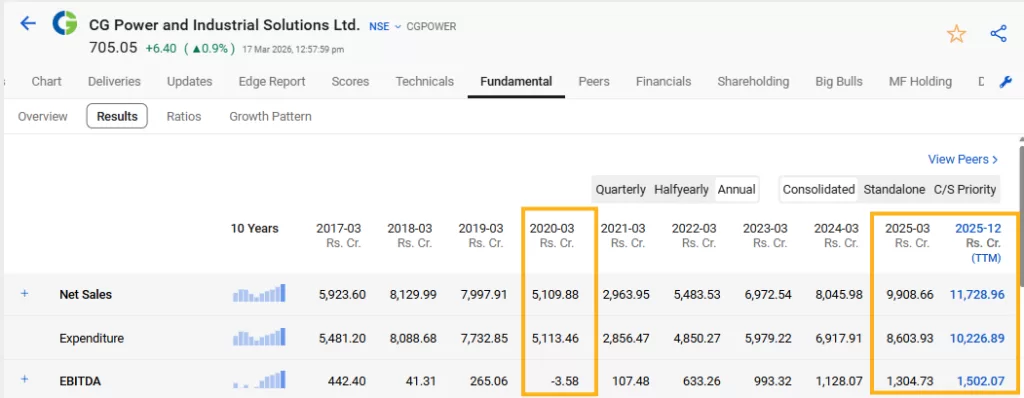
Check out the results on StockEdge
The stock that Murugappa had acquired when it was trading at ₹4 now trades around ₹706.
How Is CG Power Performing?
To understand whether a company like CG Power is performing well or merely riding market sentiment, you want to look at a few key parameters:
- Order Book & Inflow: Since most revenue is project-based, the size of the order book (especially in the Power Systems and Railways segments) is the best indicator of future revenue. CG Power and Industrial Solutions Limited reported a strong order pipeline, with order intake reaching ₹14,684 crore during the period. The company’s closing unexecuted order book stood at ₹10,631 crore, indicating a healthy backlog of projects to be executed in the coming quarters and providing strong visibility for future revenue growth.
- EBITDA Margins: Watch for “margin expansion.” As the company moves from commodity-like motors to high-margin semiconductor services and data center transformers, these margins should ideally improve.
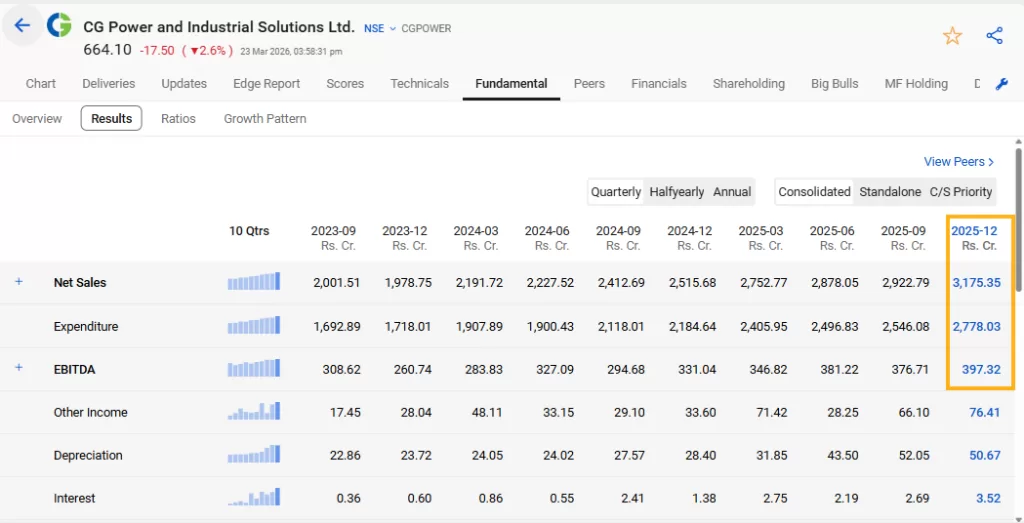
- Return on Capital Employed (ROCE): This is a key metric for the Murugappa Group. It shows how efficiently the company is using its capital to generate profits. As of early 2026, CG Power has maintained a healthy ROCE (often above 30%).
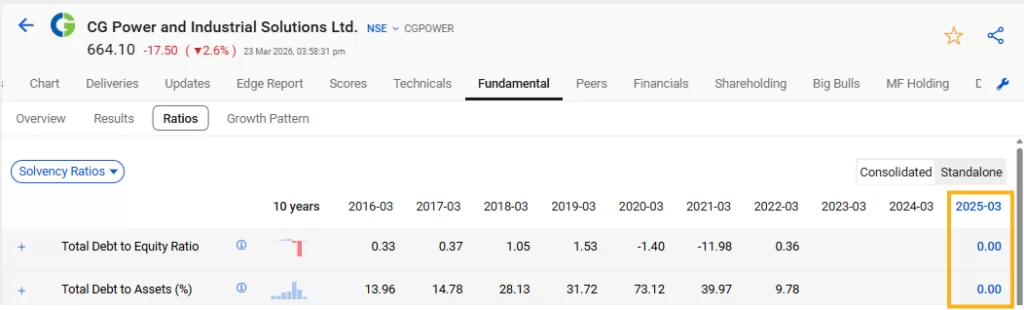
- Debt-to-Equity Ratio: Following its restructuring, CG Power has become nearly debt-free. Maintaining this low leverage while funding the capital-intensive semiconductor business is crucial.
How Will the Iran-Israel War Impact CG Power?
- Oil & Energy Price Spike: Iran is a major oil exporter and any disruption to the Strait of Hormuz pushes crude prices higher. This raises input and logistics costs for CG Power’s manufacturing operations across its plants in India.
- No Direct Asset Risk: CG Power has no manufacturing plants or major infrastructure inside Iran or Israel. Its Middle East presence is limited to CG Middle East FZE based in the UAE and a distributor network, so there is no physical asset loss to worry about.
- Export Disruption Risk: Shipping routes through the Middle East are under stress. Any prolonged closure of the Strait of Hormuz could delay raw material imports and slow down exports to CG Power’s international customers.
- Transformer & Power Demand Could Rise: Paradoxically, wars accelerate infrastructure rebuilding. Post-conflict reconstruction in the region often triggers a surge in demand for transformers, switchgear, and industrial motors: exactly what CG Power manufactures.
- Semiconductor Supply Chain Risk: CG Power’s new OSAT facility in Sanand, Gujarat, relies on global chip supply chains. A widening conflict that pulls in tech-exporting nations could tighten the availability of components and equipment needed for semiconductor assembly.
- Currency and Inflation Pressure: A geopolitical shock of this scale weakens the Indian Rupee against the Dollar. This raises the cost of any imported components that CG Power sources globally, squeezing margins in the short term.
What Does This Mean For You?
- Corporate governance matters. Even strong businesses can collapse when management integrity fails.
- A falling stock does not always mean a broken business. Sometimes the problem lies in ownership or leadership.
- Turnarounds take time. Rebuilding trust with banks, vendors, and investors is a slow process.
- Strong promoters can change the trajectory of a company. The entry of the Murugappa Group played a key role in reviving CG Power and Industrial Solutions.
- Crisis can create opportunities for patient investors. Those who recognised the underlying business potential benefited from the recovery.
Read: Top 5 Semiconductor Stocks In India
Frequently Asked Questions (FAQs)
1. What are the main business segments of CG Power?
CG Power operates in three key segments: Power Systems (transformers, switchgear, and circuit breakers for power transmission and distribution), Industrial Systems (motors, drives, and railway traction equipment), and Semiconductors, a new segment focused on chip design and outsourced semiconductor assembly and testing (OSAT) through its subsidiaries.
2. Does CG Power benefit from government initiatives like “Make in India”?
CG Power benefits from India’s push for self-reliance through higher government infrastructure spending on power grids and railway modernization, which increases demand for its motors and transformers. It also gains from PLI schemes that support electronics and semiconductor manufacturing, while import substitution policies give domestic manufacturers like CG Power an advantage in government tenders.
3. Does CG Power have exposure to the semiconductor sector?
CG Power is expanding into the semiconductor value chain through its subsidiary CG Semi, which is setting up a ₹7,600 crore OSAT facility in Sanand, Gujarat for chip assembly and testing. The company is also entering fabless chip design through Axiro Semiconductor, focusing on high-performance power and RF chips.
4. Does CG Power have direct business operations in Iran or Israel?
No significant assets. CG Power does not have major manufacturing plants or large-scale standalone infrastructure projects in Iran or Israel. Its presence in the Middle East is primarily through CG Middle East FZE (based in the UAE) and a network of distributors. The conflict is a “logistical risk” rather than a “physical asset risk.”