
By February 2026, Bajaj Finance was no longer just a lender with a strong balance sheet. It has quietly repositioned itself as a FinAI platform, a financial enterprise where artificial intelligence is embedded into underwriting, servicing, distribution, and risk management.
At first glance, Bajaj Finance Q3 results for the year 2026 appear underwhelming. Reported profits declined year-on-year, raising immediate concerns. However, this quarter is not about surface-level optics. It is about strategic intent.
In this blog, we break down Bajaj Finance Q3 Result FY26 performance, covering key financial highlights, revenue trends, asset quality, growth drivers, and the strategic decisions shaping its future trajectory.
Bajaj Finance Q3 Result Overview
Bajaj Finance reported a mixed set of numbers for the December 2025 quarter:
- Assets Under Management (AUM) grew 22% YoY to around ₹4.85 lakh crore
- Core PAT (pre-exceptional items) increased 23% YoY
- Reported PAT declined about 6% YoY due to one-time provisions
- ROE stood at ~19.6% (core), well within the company’s long-term guidance range
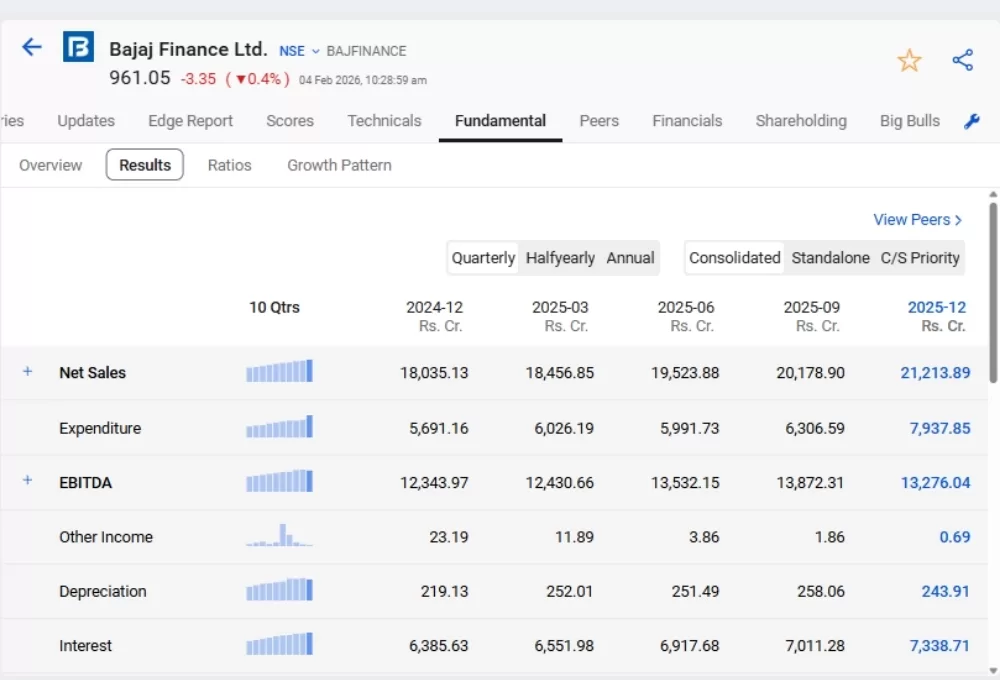
View the full report here.
The divergence between core profitability and reported earnings is the central theme of this quarter.
Key Highlights from Bajaj Finance Q3 Results
Impact of Exceptional Charges on Profitability
In this quarter, there is a gap between underlying business momentum and reported financial results due to significant one-time charges.
The business remains operationally strong. Assets Under Management (AUM) grew 22% to ₹ 485,883 crore, and Core Profit After Tax (PAT) grew 23% to ₹ 5,317 crore.
However, the reported PAT actually declined by 6% to ₹ 4,066 crore compared to the previous year. This decline was driven by a strategic decision to take a massive hit on the balance sheet now to prepare for future volatility.
One-Time Accelerated Expected Credit Loss (ECL)
The company took a one-time exceptional charge of ₹265 crore due to increased gratuity liabilities following the release of the New Labour Codes in November 2025.
The company voluntarily implemented a minimum Loss Given Default (LGD) floor across all business lines to build a “resilient balance sheet” against global volatility. This significantly increased the Provision Coverage Ratio (PCR) across all stages (Stage 1 PCR moved from 74 bps to 98 bps).
Deteriorating Asset Quality in Specific Segments
While the overall Gross NPA (GNPA) is 1.21%, specific portfolios show signs of severe stress:
- Captive 2W & 3W Finance: This segment is performing very poorly. The GNPA skyrocketed to 13.78% in Dec 2025 from 6.05% in Dec 2024. This indicates a massive failure in repayment within this specific borrower segment.
- MSME Lending: This segment holds a high GNPA of 2.71%, up significantly from 1.76% the previous year.
- Rural B2C Loans: Asset quality has weakened here as well, with GNPA rising to 1.58% from 1.84% (Note: The source says 1.84% in Dec ’25 vs 1.65% in Sep ’25, but the table shows current 1.58% vs prior year 1.84%, indicating volatility but still elevated risk compared to secured assets).
Operational Metrics and Market Footprint
Bajaj Finance’s consumer franchise remains one of its biggest competitive advantages:
- Customer base crossed 115 million, with nearly 4.8 million additions in Q3 alone
- Strong leadership in consumer durable financing, lifestyle products, and digital lending
- Presence across 4,000+ locations and 240,000+ distribution points
This omnipresent distribution network allows BFL to acquire customers at scale while maintaining credit discipline.
Loan Book & AUM Growth
Bajaj Finance Q3 result explains that the company continued to scale its balance sheet steadily during this period. Assets Under Management (AUM) rose 22% year-on-year to ₹4,84,477 crore as of 31 December 2025. On an adjusted basis, before the impact of accelerated Expected Credit Loss (ECL) provisioning, AUM stood slightly higher at ₹4,85,883 crore, compared with ₹3,98,043 crore a year ago.
Sequentially, the company added ₹23,622 crore to its AUM during the quarter, reflecting sustained demand across lending segments.
Loan origination momentum also remained strong. Bajaj Finance Q3 result shows the company has booked 13.90 million new loans in this quarter, up from 12.06 million in the same quarter last year, translating into a healthy 15% year-on-year growth.
This growth underscores continued customer acquisition and steady traction in its consumer and retail lending franchises despite a tighter risk environment.
FinAI in Execution Mode
The Bajaj Finance Q3 result for 2026 highlights FinAI as a core part of the company’s long-term strategy to build a scalable, AI-driven financial services platform. Bajaj Finance Q3 result for the year 2026 marks a shift from pilots to execution, with early gains visible across customer engagement, operations, servicing, and technology development.
The focus remains on improving productivity, reducing costs, and enhancing customer experience at scale. Here’s the core FinAI Performance Metrics
| Metric | Q1 FY26 | Q2 FY26 | Q3 FY26 |
| Voice-to-text conversions (MM) | – | – | 20.7 |
| AI-generated loan offers (Lacs) | 1.1 | 1.0 | 1.0 |
| DIY customer servicing via AI (%) | 26% | 42% | 48% |
| AI-led loan disbursements (₹ Cr) | 761 | 1,295 | 1,568 |
| Documents auto-processed for onboarding (Lacs) | 107 | 121 | 215 |
| Software developer efficiency (%) | 21% | 22% | 25% |
Strengths
- Strong Core Business Momentum: AUM grew 22% YoY to ₹4,85,883 crore, while core PAT (excluding exceptional items) rose 23% to ₹5,317 crore, indicating healthy underlying profitability despite conservative provisioning.
- Subsidiaries Adding Meaningful Value: Bajaj Housing Finance reported steady growth with AUM up 23% and PAT up 21% YoY. Bajaj Financial Securities delivered standout performance, with AUM surging 63% and PAT rising 74%, reflecting operating leverage and rising market participation.
- Consistent Customer Addition: The company added 4.76 million new customers during the quarter, taking the total customer base to 115.40 million, reinforcing scale-led growth advantages.
- Improving Cost Efficiency: Opex-to-Net Total Income ratio improved to 32.8% (vs 33.1% YoY), supported by accelerated adoption of AI across underwriting, servicing, and collections.
- Strong Capital Position: Capital adequacy remains comfortable with CRAR at 21.45% and Tier-1 capital at 20.60%, providing sufficient buffer for growth and potential asset-quality stress.
- Wide Omni-Channel Presence: The franchise continues to benefit from scale, with operations across 4,052 physical locations and a strong digital ecosystem of 82.53 million net app users.
Risks
- Rising Stress in Select Loan Segments: While overall GNPA is contained at 1.21%, captive 2W & 3W finance saw GNPA spike to 13.78% (from 6.05% YoY). MSME GNPA rose to 2.71%, and car loans increased to 1.49%, indicating emerging stress pockets.
- Pressure on Reported Earnings: Reported consolidated PAT declined 6% YoY to ₹4,066 crore due to one-time charges, including ₹1,406 crore of accelerated ECL provisions and a ₹265 crore impact from new labour codes.
- Macro-Economic Uncertainty: Management highlighted global economic volatility as a key risk, prompting conservative provisioning to strengthen balance sheet resilience.
- Housing Portfolio Attrition: Bajaj Housing Finance reported higher portfolio churn, suggesting competitive pressures from balance transfers and prepayments, which could moderate AUM growth.
- Regulatory Overhang: The financial impact of new labour codes underscores ongoing regulatory risks that could periodically affect profitability.
Future Outlook
Bajaj Finance’s long-term roadmap reflects disciplined ambition rather than aggressive overreach. The company is targeting AUM growth of 25-27% and profit growth of 23-24%, with FY26 expected to be a milestone year as AUM crosses ₹5 lakh crore and loan disbursements exceed 50 million.
By FY30, the customer franchise is projected to expand to 200–220 million, supported by a growing cross-sell base of 120-130 million customers. Importantly, this scale-up is designed to remain highly profitable, with a sustainable ROA of 4.3-4.7% and ROE of 19-21%.
Strategically, the LRS 2026-30 framework anchors growth around customer-centricity, lowest-risk positioning, and technology leadership.
The FinAI transformation plays a central role, with AI-driven underwriting, servicing, and agentic automation expected to improve efficiency, lower costs, and strengthen risk control, positioning Bajaj Finance as a future-ready financial platform.
Conclusion
While reported profits declined due to proactive provisioning, the core business remains strong, asset quality is stable, and operating efficiency is improving. The company has chosen resilience over short-term optics, strengthening its foundation for long-term value creation.
Read this detailed analysis on Zomato Q3 Result: Why Did The Stock Go Down? to get the full story
Frequently Asked Questions (FAQs)
1. What is Bajaj Finance Q3 net profit in 2026?
Bajaj Finance reported a consolidated net profit (Profit After Tax) of ₹ 4,066 crore for Q3 FY26, which reflects a 6% decline due to accelerated provisions, while the core net profit excluding exceptional items grew by 23% to ₹ 5,317 crore.
2. How did the subsidiaries perform?
Bajaj Housing Finance delivered steady performance with 21% profit growth, while Bajaj Financial Securities registered hyper-growth with a 74% surge in profit and 63% increase in AUM.