
Everyone is searching for the next multibagger stock. But in reality, most investors end up chasing momentum, market noise, and social media hype without understanding the actual business behind the stock.
A company’s share price may rise sharply in the short term, but long-term wealth creation usually comes from fundamentally strong businesses with healthy profits, manageable debt, strong cash flows, and quality management.
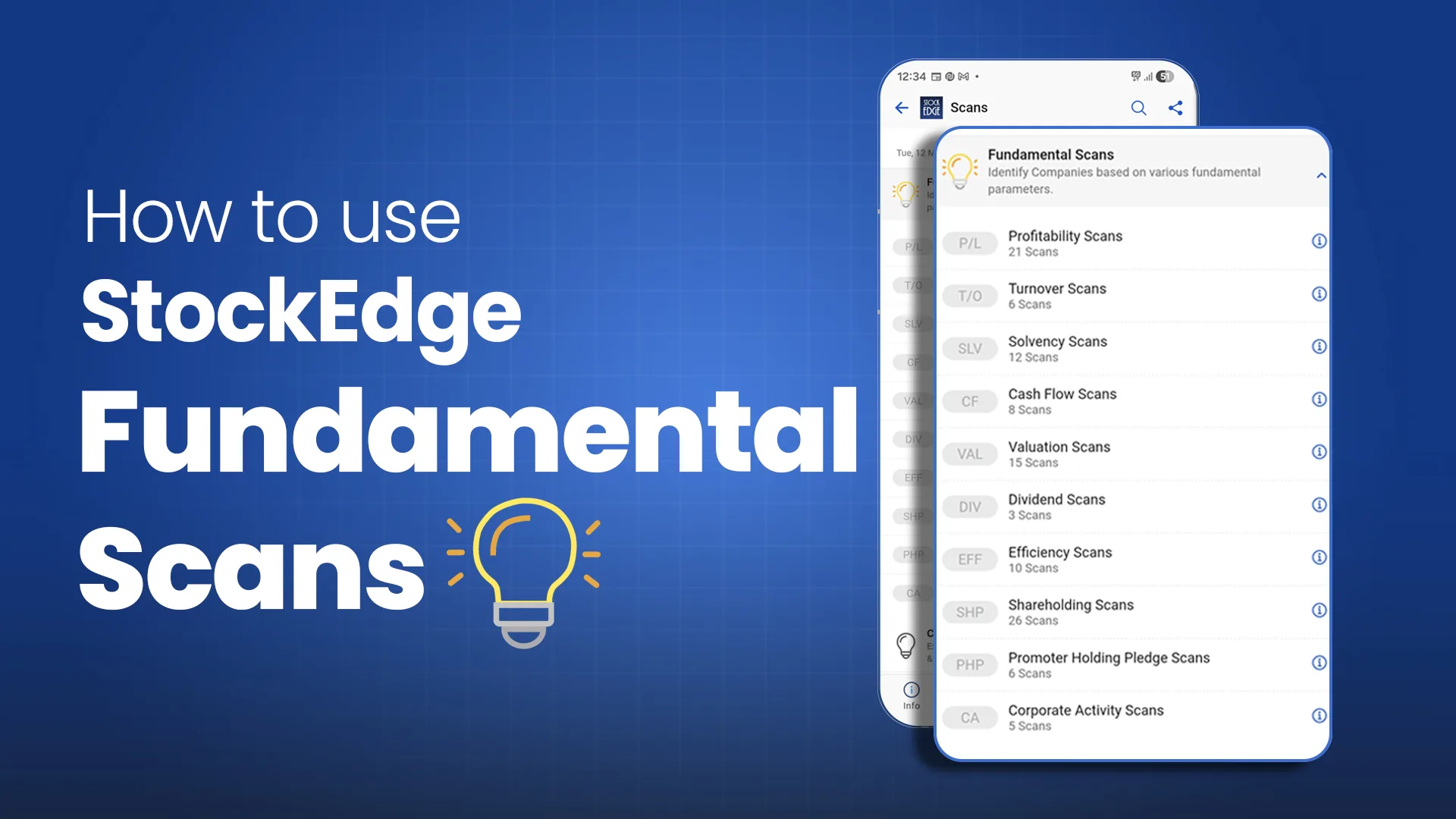
This is where StockEdge Fundamental Scans become incredibly useful. In this blog, we will understand how to use StockEdge fundamental scans effectively.
What are Fundamental Scans by StockEdge?
Fundamental Scans by StockEdge are pre-built screening filters that sort and rank stocks based on key financial and business metrics. Unlike technical scans that focus on price and volume patterns, fundamental scans evaluate the underlying financial health of a company, including its profitability, debt levels, cash flows, valuations, and corporate governance indicators.
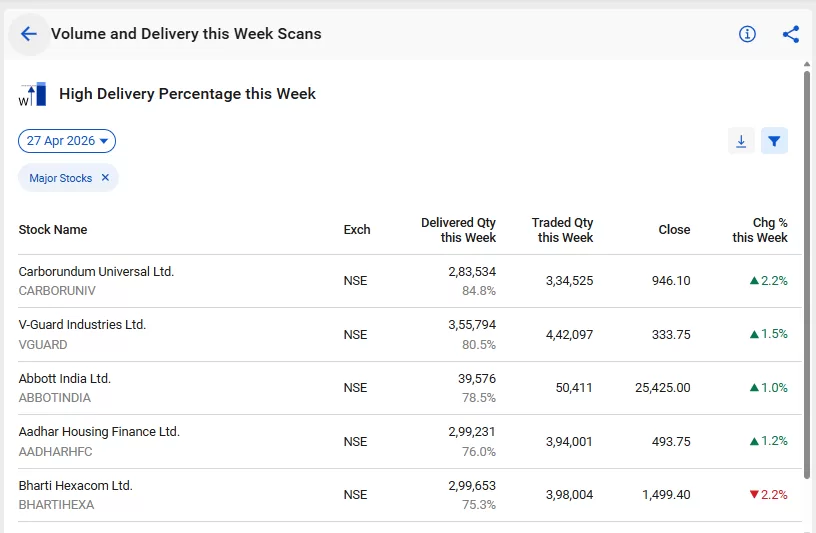
For stronger conviction, combine with Price Action Scans, Volume & Delivery Scans. Multiple confirmations improve reliability.
Why Do You Need Fundamental Scans Data for Trading?
Many traders focus exclusively on price charts and technical patterns, but experienced market participants understand that sustainable wealth creation requires a solid fundamental foundation. Here is why fundamental scan data is indispensable:
- Helps identify financially strong companies using key financial metrics
- Reduces risk by filtering out weak businesses with high debt or poor earnings
- Finds quality stocks available at reasonable valuations
- Tracks promoter holding and pledge data for governance insights
- Improves buy/sell decisions when combined with technical analysis
- Saves time by scanning and filtering thousands of stocks automatically
How to Use StockEdge Fundamental Scans
StockEdge Fundamental Scans are designed to help investors easily filter and identify stocks based on important financial parameters like valuation, growth, profitability, and debt. Follow these steps to make the most of this feature:
- Open the StockEdge app or web platform and log in to your account
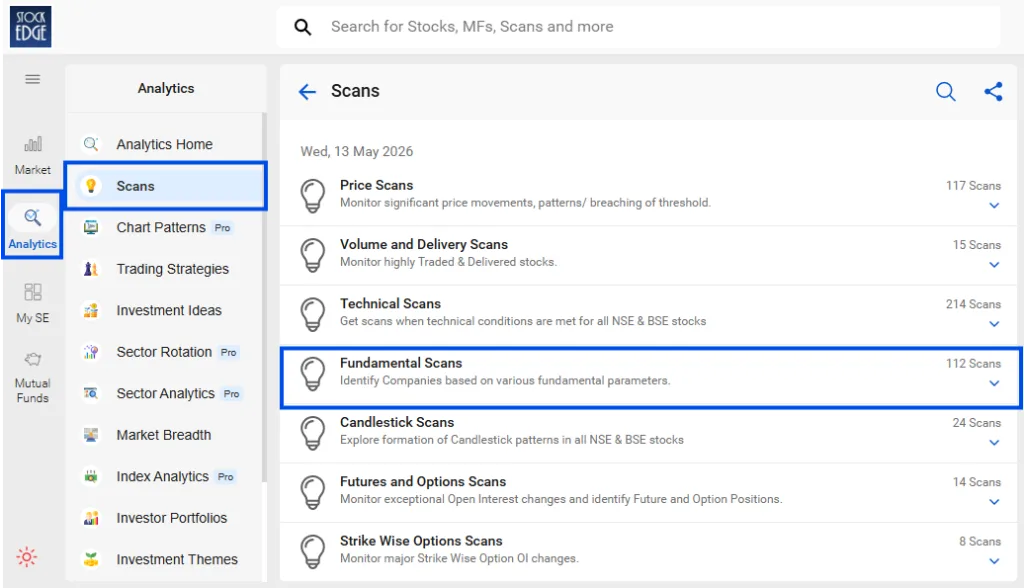
- Go to Analytics → Scans from the main dashboard
- Select the Fundamental Scans category
- Choose the scan type based on your objective, such as Profitability, Valuation, or Cash Flow
- Review the list of stocks matching the selected criteria
- Combine multiple scans to filter stronger investment opportunities more effectively
Types of StockEdge Fundamental Scans
StockEdge organizes its fundamental scans into clearly defined categories, each targeting a specific dimension of a company’s financial health. Here is a detailed look at each category:
Profitability Scans
Profitability scans filter companies based on how efficiently they generate profits from their operations and assets. Key metrics covered include:
- Return on Equity (ROE): Measures how effectively a company generates profit from shareholders’ equity.
- Return on Capital Employed (ROCE): Evaluates profit generation relative to total capital deployed in the business.
- Net Profit Margin: The percentage of revenue that translates into actual profit.
- EBITDA Margin: Indicates operating efficiency before the impact of financing decisions and accounting choices.
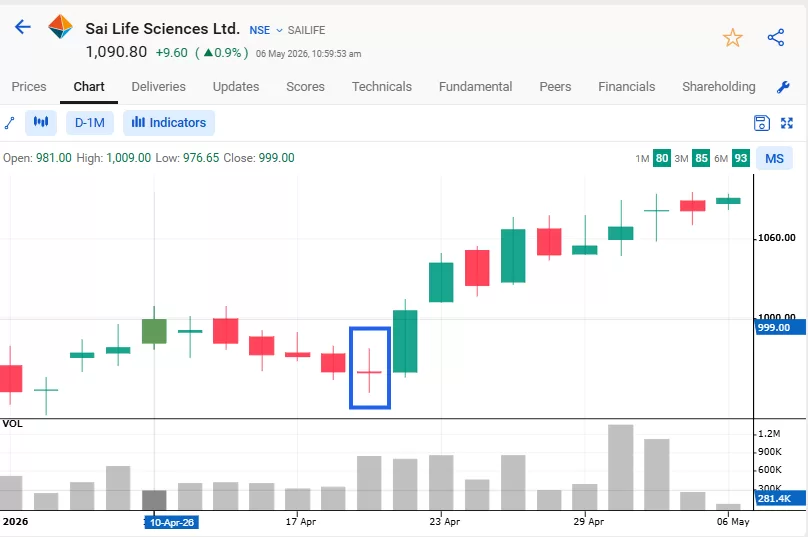
Use these scans to find companies with consistently high and improving profitability, which is often a hallmark of competitive advantage and quality management.
Turnover Scans
Turnover scans assess how efficiently a company utilizes its assets and manages working capital. Important ratios include:
- Asset Turnover Ratio: Reveals how much revenue a company generates per rupee of assets.
- Inventory Turnover: Tracks how quickly a company sells and replenishes its inventory.
- Debtors Turnover: Measures how efficiently receivables are collected.
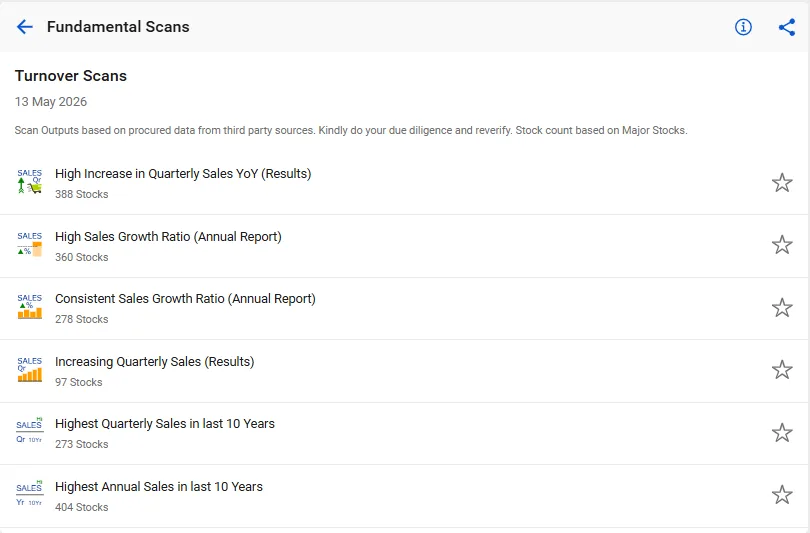
High turnover ratios generally indicate a capital-efficient business model, which can support higher returns even at modest profit margins.
Solvency Scans
Solvency scans evaluate a company’s ability to meet its long-term financial obligations and survive periods of financial stress. Key metrics include:
- Debt-to-Equity Ratio: Shows the proportion of debt relative to shareholder equity.
- Interest Coverage Ratio: Indicates how comfortably a company can pay interest on outstanding debt.
- Current Ratio and Quick Ratio: Assess short-term liquidity and the ability to meet near-term liabilities.
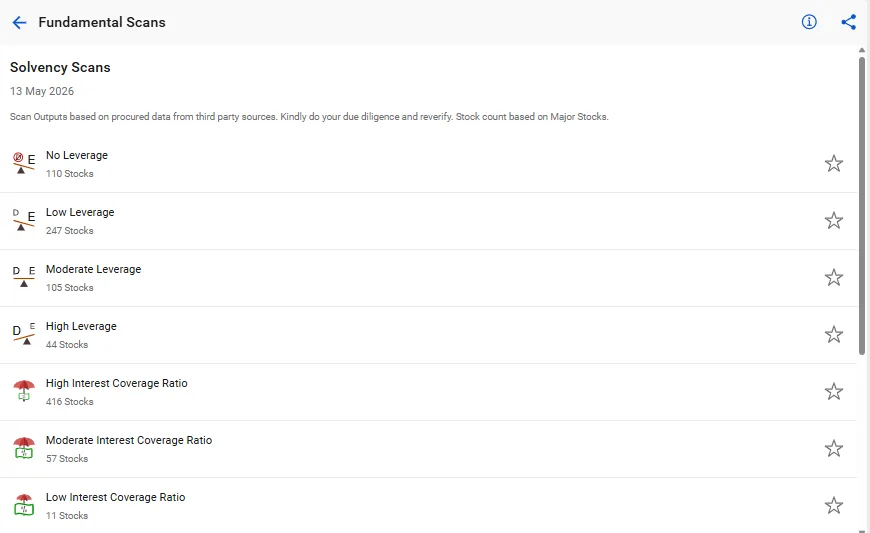
Solvency scans are particularly useful in high-interest-rate environments, where over-leveraged companies face elevated risks. Filtering for low debt and strong coverage ratios can help you avoid potential bankruptcies or equity dilutions.
Cash Flow Scans
Cash flow is often called the lifeblood of a business. Companies can show accounting profits while actually burning cash. Cash flow scans cut through this noise by focusing on:
- Operating Cash Flow (OCF): Indicates how much cash the core business operations generate.
- Free Cash Flow (FCF): Represents cash available after capital expenditure, which can be used for dividends, buybacks, or debt repayment.
- Cash Flow from Operations to Net Income Ratio: Helps verify the quality of reported earnings.
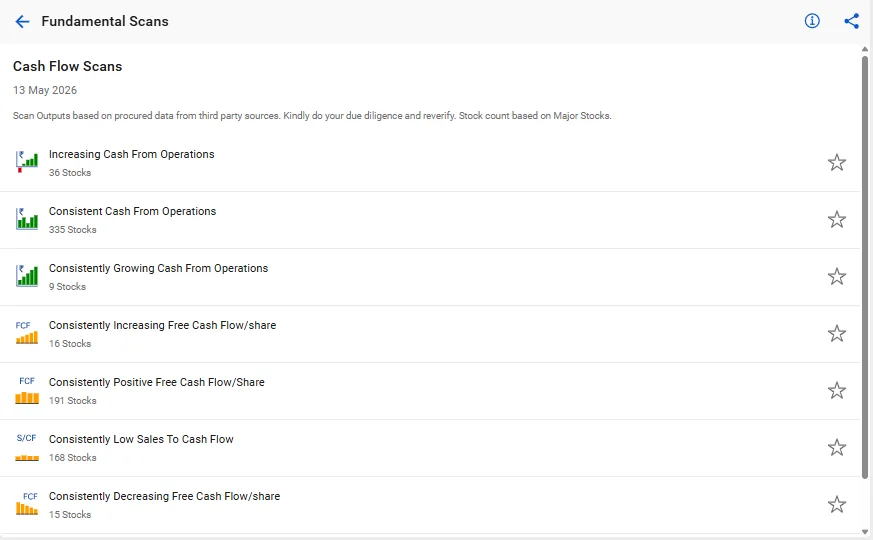
Consistent positive free cash flows are a strong indicator of business quality and financial sustainability, making these scans invaluable for long-term investors.
Valuation Scans
Valuation scans help you determine whether a stock is trading at a fair price relative to its earnings, book value, or sales. Common valuation metrics tracked include:
- Price-to-Earnings (P/E) Ratio: Compares stock price to earnings per share.
- Price-to-Book (P/B) Ratio: Compares market capitalization to net asset value.
- EV/EBITDA: A capital-structure-neutral valuation multiple favored by analysts.
- PEG Ratio: Adjusts P/E for earnings growth rate, helping identify growth stocks at reasonable prices.
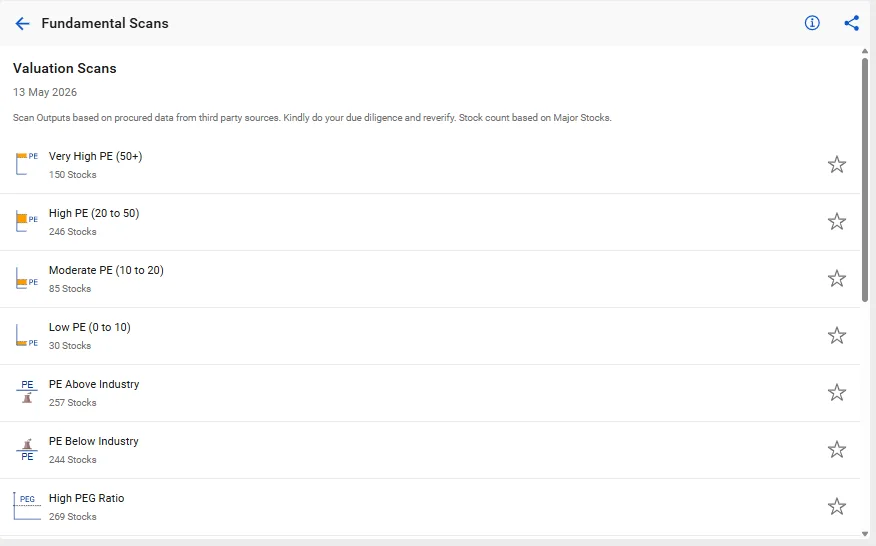
These scans are best used in combination with profitability and growth filters to avoid cheap stocks that are cheap for good reason.
Dividend Scans
For income-oriented investors, dividend scans are an essential tool. They help identify companies with:
- High Dividend Yield: Stocks offering attractive income relative to their current market price.
- Consistent Dividend History: Companies that have paid dividends regularly over multiple years.
- Dividend Payout Ratio: This shows that the company is consistently sharing a significant part of its earnings as dividends with its shareholders despite of all scenarios and events.
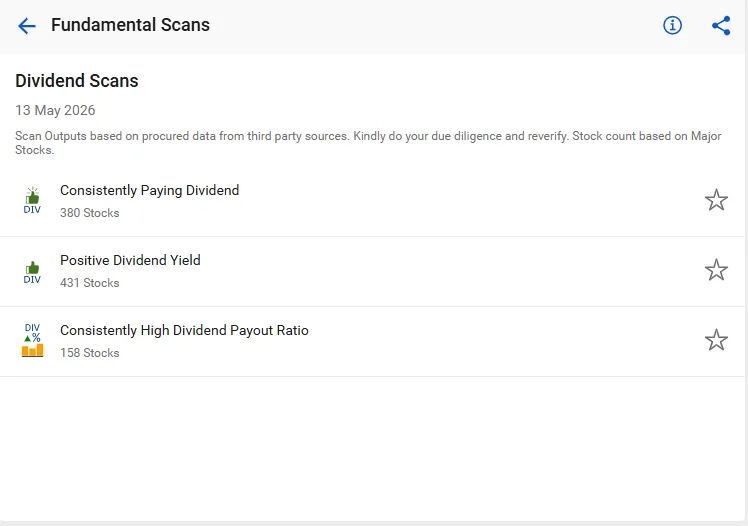
Dividend scans are particularly popular among retirees and conservative investors who prioritize regular income alongside capital preservation.
Efficiency Scans
Efficiency scans go beyond basic profitability to evaluate how well management deploys resources. These scans look at:
- Receivable Days – Measures how quickly a company collects payments from customers
- Payable Days – Tracks how efficiently a company manages supplier payments
- Inventory Turnover – Shows how fast inventory is converted into sales
- Working Capital Efficiency – Evaluates how effectively short-term assets and liabilities are managed
- Asset Turnover Ratio – Indicates how efficiently assets generate revenue
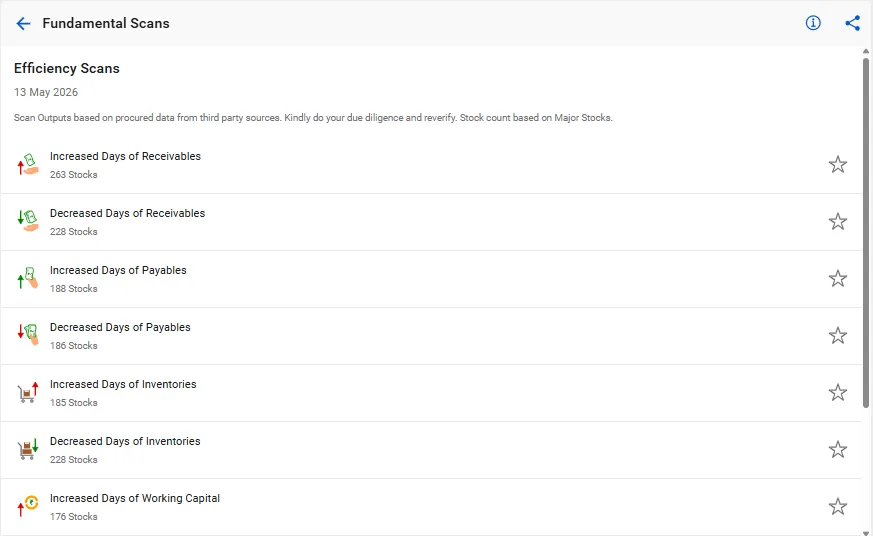
These metrics are especially relevant for manufacturing, retail, and infrastructure companies where operational efficiency directly impacts bottom-line performance.
Shareholding Scans
Shareholding pattern data is a goldmine of information that many retail investors overlook. StockEdge’s shareholding scans track changes in ownership structure, including:
- Foreign Institutional Investor (FII) Buying or Selling: Shows whether global smart money is entering or exiting a stock.
- Domestic Institutional Investor (DII) Activity: Tracks mutual fund and insurance company buying patterns.
- Promoter Shareholding Trends: Rising promoter holding is generally a bullish indicator, while consistent selling raises red flags.
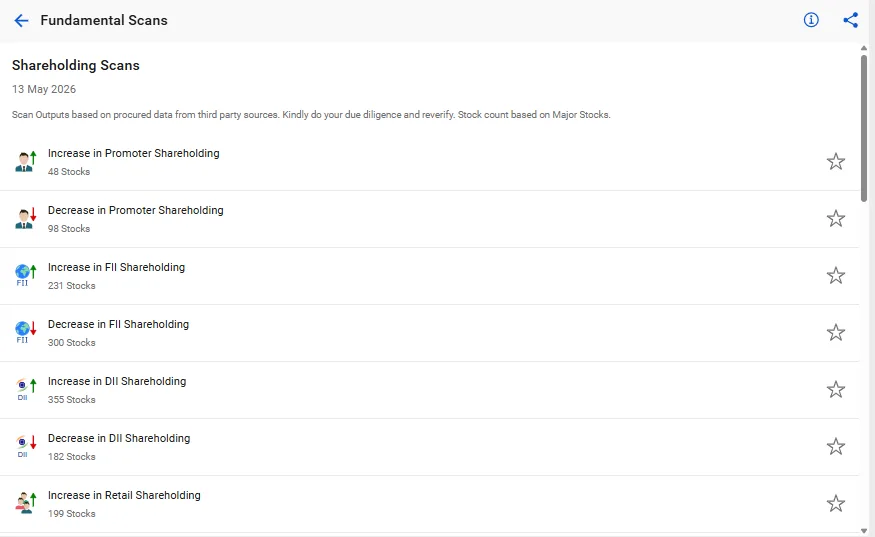
Tracking institutional ownership trends can help you align with informed investors who have done extensive due diligence.
Promoter Holding Pledge Scans
One of the most critical risk indicators in the Indian market is promoter share pledging. When promoters pledge their shares to raise loans, it creates a fragile ownership structure.
StockEdge’s promoter pledge scans help you:
- Identify companies where a high percentage of promoter shares are pledged.
- Spot situations where pledge levels are increasing quarter over quarter.
- Find companies that have been reducing pledges, which signals improving financial health.
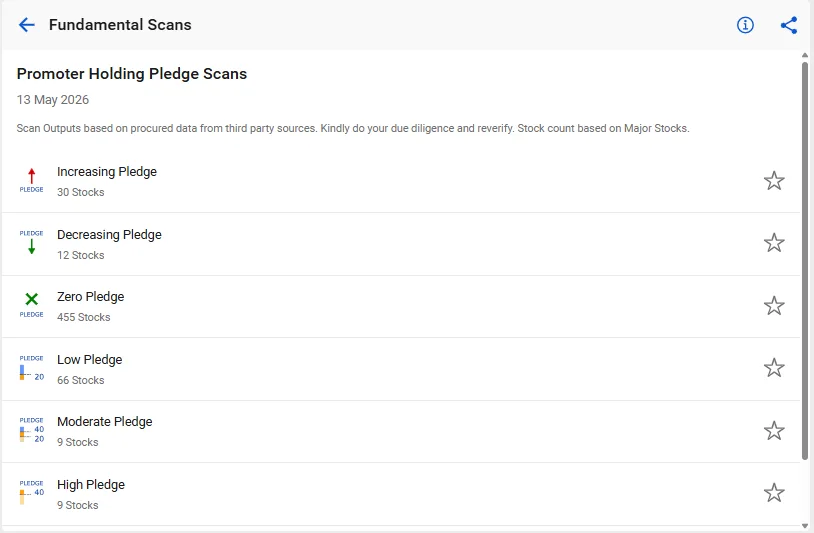
High pledge levels can lead to forced selling by lenders in the event of margin calls, causing sharp stock price declines. Avoiding such stocks or monitoring them closely is a prudent risk management practice.
Corporate Activity Scans
Corporate activity scans track significant business events and announcements that can impact stock prices and investor sentiment. These include:
- Mergers and Acquisitions: Companies engaged in strategic buyouts or being targeted for acquisition.
- Bonus Issues and Stock Splits: Corporate actions that affect share price and liquidity.
- Buyback Announcements: Companies repurchasing their own shares often signal management confidence in future prospects.
- New Project Announcements and Capacity Expansions: Indicators of future revenue growth.
- Board Meetings and Earnings Results: Timely alerts for upcoming financial disclosures.
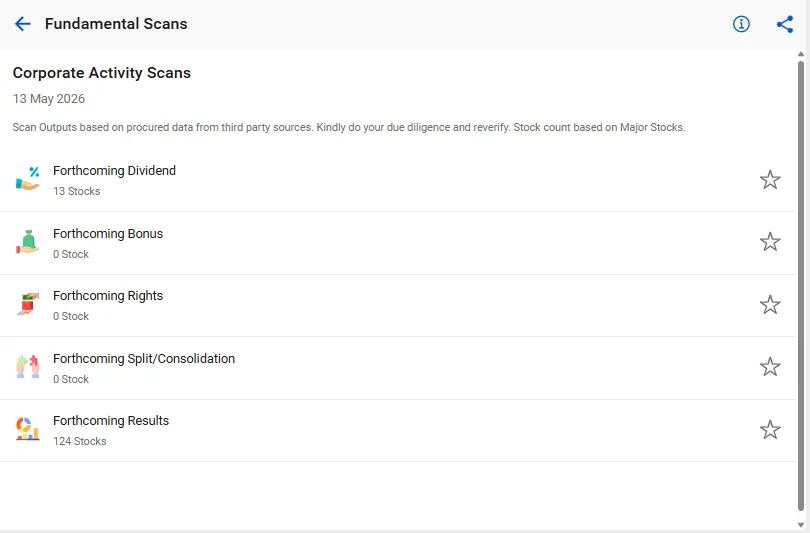
Corporate activity scans are especially useful for event-driven investors who look to capitalize on announcements and catalysts that the broader market may not have fully priced in.
Suggested Read: How StockEdge Screener Works: 7 Useful Scans Explained
How to Combine Fundamental Scans Using the StockEdge Fundamental Score
Running individual scans across profitability, valuation, cash flow, and other categories gives you powerful insights, but cross-referencing multiple scans manually can still be time-consuming. This is where the StockEdge Fundamental Score brings everything together.
The Fundamental Score is a composite tool that aggregates more than 30 financial metrics into a single score out of 100, giving you an instant snapshot of a company’s overall financial health. Rather than juggling separate scan results, you get one unified number that reflects how a stock performs across six key pillars:
- Growth – Is the company expanding its revenues and profits consistently?
- Profitability – Does it generate strong returns on equity and capital?
- Efficiency – How well does management deploy assets and manage working capital?
- Solvency – Is the company’s debt load manageable and its liquidity healthy?
- Quality – Are earnings backed by real cash flows and sound governance?
- Valuation – Is the stock priced reasonably relative to its fundamentals?
A higher Fundamental Score indicates a company that scores well across most or all of these pillars, while a lower score can quickly flag businesses with hidden weaknesses that may not be obvious from any single scan alone.
Suggested Read: How to Use StockEdge Fundamental Score Scans
Let’s understand with an example, Avenue Supermarts Ltd. (DMart), one of India’s most trusted retail giants, currently holds an average fundamental score of 57/100, and here’s why.
The company’s growth trajectory has strengthened considerably compared to 2021, and its debt-free status lends a strong solvency score, while management quality remains a standout attribute keeping the quality score high.
However, profitability ratios have been on a declining trend since 2023, which stands out as the weakest link in its overall fundamentals. Adding to the concern, receivable days and working capital days have been rising consistently, putting pressure on cash flows and pulling the overall rating down to average.
On the valuation front, the stock currently trades at a premium relative to its peers, making it expensive at current levels. Given these dynamics, the prudent approach would be to book profits at this stage and look to re-enter on dips — particularly once there are visible signs of improvement in the receivables cycle and working capital management.
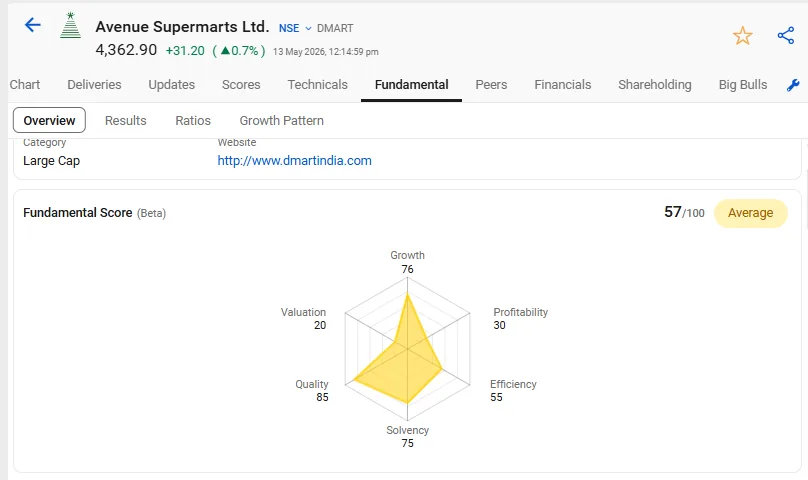
Fundamental Score of DMart
Conclusion
StockEdge Fundamental Scans are a game-changer for investors who want to make data-driven decisions without spending countless hours poring over financial statements. By covering every critical dimension of a company’s financial health, from profitability and cash flow to valuations and corporate governance, these scans provide a comprehensive toolkit for building a robust investment portfolio.
What we are covering next: How To Use StockEdge Candlestick Scans
Frequently Asked Questions (FAQs)
1. Why are fundamental scans important for investors?
Fundamental scans help investors quickly identify fundamentally strong companies based on financial performance, valuation, growth, profitability, and debt levels. They simplify stock research and support data-driven investment decisions.
2. Which fundamental ratios are covered in StockEdge scans?
StockEdge fundamental scans cover a wide range of financial ratios and metrics, including ROE, ROCE, net profit margin, EBITDA margin, debt-to-equity ratio, interest coverage ratio, P/E ratio, P/B ratio, EV/EBITDA, dividend yield, free cash flow, asset turnover ratio, and many more.
3. What is the difference between technical scans and fundamental scans?
Fundamental scans analyze a company’s financial strength and business performance for investing. Whereas technical scans analyze price, volume, and chart patterns for trading opportunities.